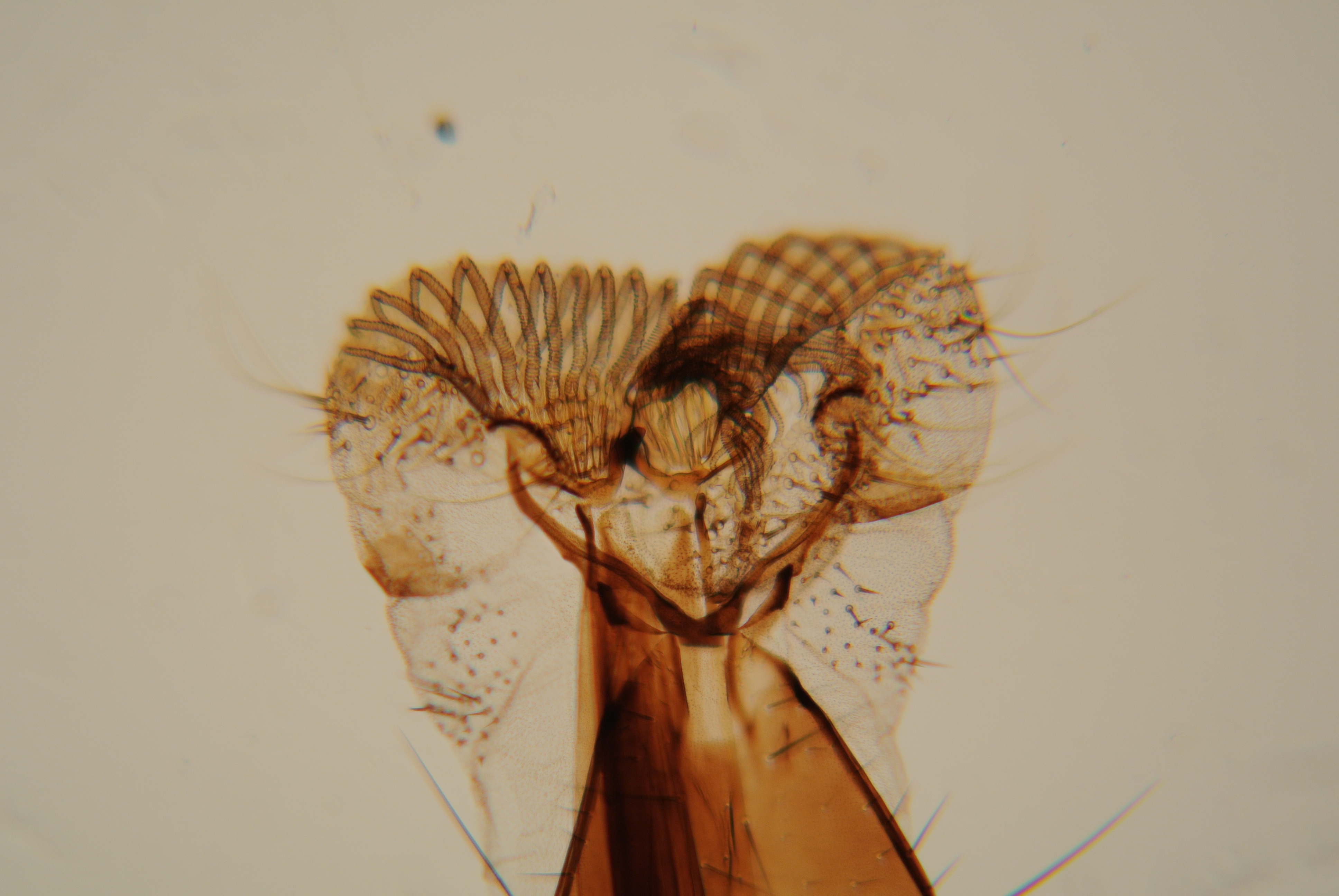
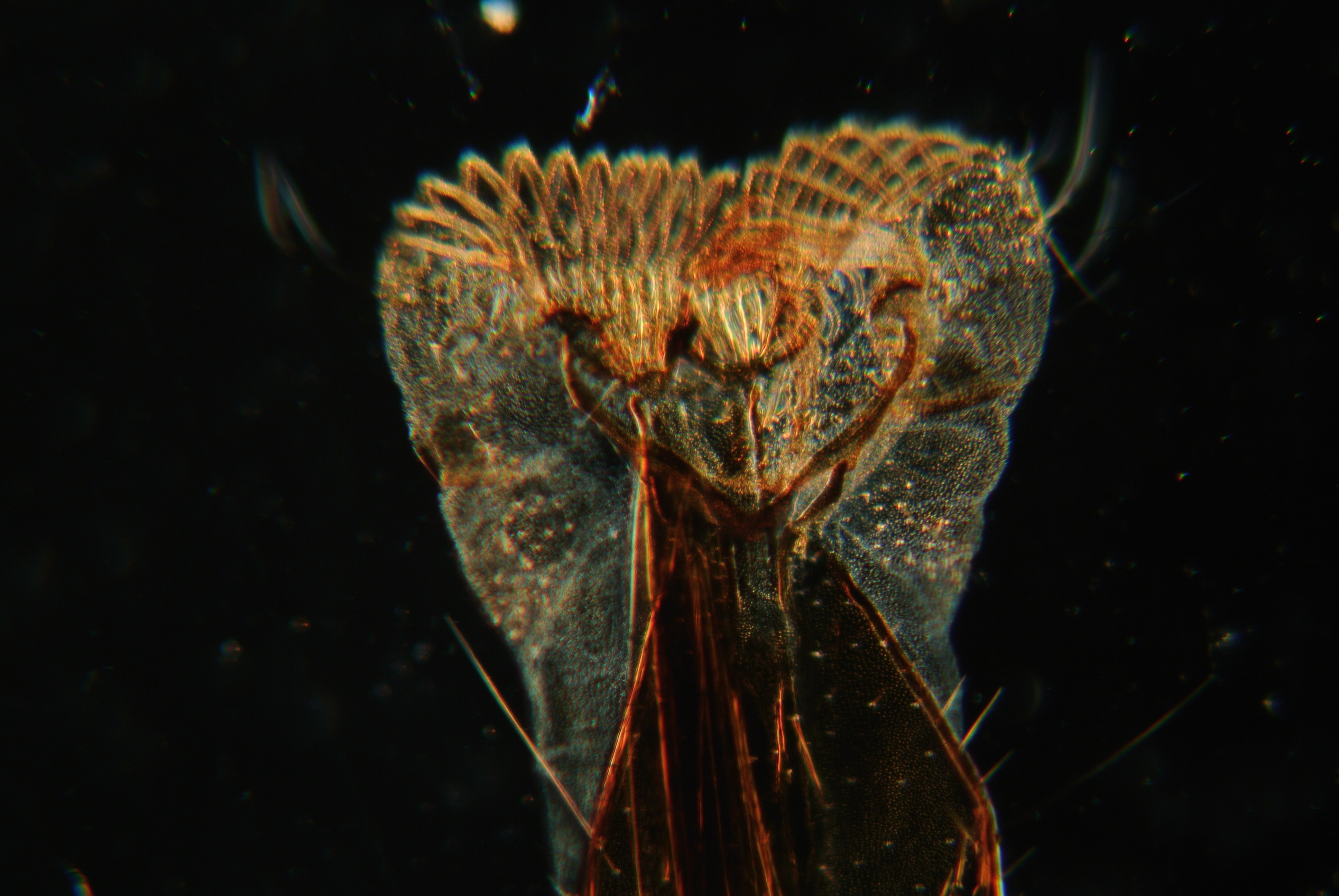
Cats Whisker Forceps

A recent brush with greatness (see this excellent chap) inspired me to work on a few opaque, dry-cell, mounts. This of course reminded me that I have always lacked a delicate touch. -K

Delicate Objects

When mounting one is apt to run into all manner of materials, from algae too zea stems there is no limit to what one might encounter. While some of the objects to be mounted are simple to manipulate with droppers, section lifters, or brushes, a few require a forceps to be handled effectively. Unfortunately, some of what one may wish to mount is fragile (part of the reason one will want to protect it with a sturdy mount) and the usual forceps will be sure to result in damage unless one is possessed of the most careful hand. There is, of course, specialized equipment for working with small (right down to the truly microscopic) objects; specialized equipment for working with delicate objects; specialized equipment for working with small delicate objects; and it is nearly all difficult to find and expensive.

The Old Solution

The old solution was a simple modification to the common sort of forceps or needle. It proved such a fine remedy to the problem that few who make use of it are unimpressed. In fact, the solution was so elegant that one can still pay (exorbitant prices; $12.00 is usual) for professional equipment making use of the common (wait for it…) eyelash. When a small and delicate specimen had to be manipulated the workers of old would cement an eyelash, for the finest objects, or cats whisker to the usual needle holder or standard forceps and thereby create a more exacting tool without recourse to more expensive instruments.

As a Probe or Pick

If one must manipulate a small object, perhaps pollen or butterfly scales, a straight eyelash bound to a suitable handle will do nicely. It was once (inappropriately enough) thought that lashes from particular genders or ethnicities were superior and catalogs often boasted about the origin of their offerings as being more gracefully curved or uniformly black. Todays suppliers are rather ambiguous as to the source of their offerings and the eyelashes themselves may be human or otherwise. If one takes any comfortable handle, and cleans of oil with a solvent (alcohol-ether 50% would have been traditional) an eyelash, it may be fixed to that handle by a drop of balsam or a few wraps of thread. Such a tool comes to a very fine point that is surprisingly resilient, easily visible, and not prone to breaking, This last point rather important as any who have wade use to the thread of glass micro-manipulators may attest.

As a Forceps

For a larger object an eyelash may prove insufficient when fixed to the end of a dime-store forceps, and that is where a certain degree of preference comes in. Some historic texts make reference to using the bristles of a pig or hair from the white-tailed deer. For a modern worker those materials may prove difficult to come by. One might instead give their floors a sweep and recover a whisker or two from the family cat. Cutting away the very fine half nearest the tip, set it aside for use as with an eyelash, one should then affix the more robust end to a convenient forceps.

Such a tool at times seems to work wonders, as objects may now be grasped without fear of crushing. In truth one would be hard pressed to hold an object so tightly with such a device as to cause damage. Simultaneously, one may be assured of a sound grip. Considering the price of similarly fine ready-made forceps, the result is better than might be otherwise possible.

Determining Objective Magnification

Here’s hoping this is useful as more than just an academic exercise. -K

In the previous post we looked at equivalent focus as it relates to the power of an objective. It was noted that the power marked explicitly on ones objective is sometimes at odds with that implied by the equivalent focus. Today we’ll look at one way to determine the actual power of a given objective. The method used is among the more equipment heavy, but it is also one of the least demanding so far as manipulations go.

One will need the following:

  • A microscope with a draw tube (or an eyepiece collar)
  • A 10x Huygenian eyepiece
  • A 10x Ramsden eyepiece
  • A stage micrometer
  • An ocular micrometer (installed in the Ramsden eyepiece)

Method

Using the Huygenian ocular, with the stage micrometer as an object, and the draw tube set to the length for which the objective is corrected (160 in most cases) the objective to be measured is brought into sharp focus. The Huygenian ocular is then replaced with the Ramsden and everything brought into sharp focus by moving in or out the draw tube. One must not focus using the microscopes coarse or fine adjustments.

Line up the rulings of the stage micrometer so that a given number corresponds with a particular span of the rulings on the ocular micrometer. Be sure that the rulings are lined up consistently, do not measure from the outside of the line in one place and the inside in another. Use as much of the available rulings as possible for increased accuracy. Write down the rulings on the stage micrometer that are required and the corresponding number from the ocular.

Now divide the distance of the rulings on the ocular by the distance of the rulings on the stage. The dividend is the ocular independent magnification of the objective.

In Practice

A stage micrometer is measured against the Ramsden micrometer eyepiece as described above. Rulings on the stage micrometer are .01mm apart and rulings on the eyepiece micrometer are .1mm apart. It is found that 95 rulings on the stage micrometer correspond exactly to 98 rulings on the eyepiece micrometer.

9.8mm / .95mm = 10.3

The objective then, provides 10.3X magnification.

With a different objective it is found that 15 rulings on the stage micrometer correspond to 65 rulings on the eyepiece micrometer. Once again we work in consistent units of measure.

9.3mm / .22mm = 42.27

The objective then, provides 42.27X magnification.

In Theory

Some users may immediately wonder why it is emphasized that one must focus with a Huygenian ocular, only to replace it with a Ramsden fitted with a micrometer, and manipulate the draw tube for focus. Why shouldn’t one simply use a Huygenian ocular fitted with a micrometer? After all it works for measuring structures.

First consider the construction of a Ramsden ocular. The positive ocular forms a real image below its field lens, outside of the influence of the oculars magnification. A Hugenian ocular, a negative ocular, only forms a real image after light from the objective passes through its field lens. The upshot of which is that a Huygenian ocular will measure an objective as more powerful than it is.

Why then does it mater if one focuses with a negative ocular like the Huygenian but measures with a positive ocular like the Ramsden? The simple explanation is that doing so negates the magnification that results from the eye viewing a virtual image on which a real image of a ruled reticule has been overlaid. Using the Ramsden only will again result in a distortion of the objectives power.

Notes:

∗An eyepiece collar is a small, friction fit, split disc which rides around the outside barrel of an eyepiece and prevents it from seating fully into the microscopes body tube. Such a collar can provide a microscope not equipped with a draw tube with much of the same functionality.

†A Huygenian filar micrometer used with the objectives above measures their powers as 11.37X and 47.8X respectively.

‡In this case the Ramsden eyepiece alone measures the objectives powers as 10.2X and 43.3X. These distortions represent the degree to which the focus was adjusted by manipulation of the draw tube after switching from the Hugenian ocular to the Ramsden.

Equivalent Focus

Just a little something a fair number of microscopists do not realize, or give much thought if they do. -K

For many, equivalent focus is nothing more than a little marking on their objectives or nosepiece. Modern objectives are apt to be marked with all manner of things, most commonly it will include the following: the manufacturer, a serial or part number, the power, the numerical aperture, and the equivalent focus in millimeters. Less commonly an objective might also be marked with patent dates or numbers, the immersion medium (if any), the variety of lens system, the proper tube length, specialty symbols for infinity correction, colors designating various powers, intended coverglass, marking for correction collars, even zoom or variable focus markings. Most of the markings are self explanatory, but equivalent focus can be a bit confusing.

When working with antique or vintage gear the equivalent focus (hereafter abbreviated EF) may be even more complicated, and more useful. The farther back one goes the more likely one is to find less explicit information marked on ones objectives. Sometimes the only information will be the manufacturer and the EF, if one’s particularly lucky the tube length will be marked as well.
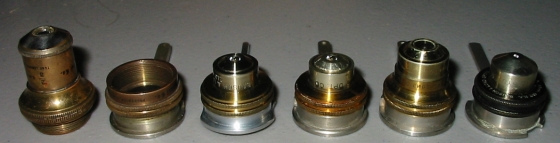
None of these objectives are marked with their explicit magnification.

None of these objectives are marked with their explicit magnification.

In the above photo one can see a variety of objectives. At the far left is an old system objective marked 2/3 0.25N.A. 160 Tube Length, comparatively explicit as we shall see and oddly mixing metric tube length with a fractional inch EF. That to it’s immediate right is marked only with its EF, 32mm. Beside that is one marked 4mm 0.85 215mm T.L. its neighbor is the same in all respects but for a 165mm tube length. Next is an 8mm 0.50 N.A. for 215mm T.L and finally a 1.9mm 1.32N.A. fluorite for 215mm tube length.

What is Equivalent Focus?

The equivalent focus is a means of expressing the power of an optical system. Instead of expressing that directly as a diopter measurement, or explicitly as the diameters of magnification, it is provided as it relates to the focus of a simple lens at a distance of ten inches. This seems an odd way to describe the magnification of any optical system, until one recalls that the microscope is built around the natural relaxed focus of the human eye; ten inches. It seems even more odd now that the metric system has been universally adopted by microscope manufacturers, and microscopes are no longer physically ten inches in length.

Determining Magnification from Equivalent Focus

For quite a long time the older system of measure was used extensively and objectives would be marked with a focal length expressed in fractional inches. When the microscope used a tube length of 10 inches the mathematical determination of magnification from EF was very simple.

Tube length / fractional EF = magnifying power

One may determine the power of a 1 inch EF objective immediately because at ten inches it provides a magnification of 10X. A 1/2 inch objective then provides a magnification of 20X, a 2/3 inch objective provides 15X, 1/6 inch provides 60X, and so on. Relatively simple, and although less direct than marking an objective with the power itself, fractional inches are easy to convert to magnifying power. When the 160mm tube length became common, if not standard, fractional EF was still used and manufactures simply modified the actual power of the eyepieces to provide the marked magnification.

After metric measurements became standard§ the equivalent focus could still be used to quickly determine the magnifying power. Using the above equation one could simply substitute the metric tube length for the metric EF. A 25mm EF objective intended for a 250mm tube length would provide a power of 10X. A 16mm objective for a 160mm tube length system also provided a magnification of 10x.

Things Get Complicated

One with any experience with microscopes is apt to immediately find that their objectives do not bear out the above equations when using other metric EF’s. A common B&L objective marked 4mm might also be marked 43X rather than the 40X one would expect. Is one to believe then that the objective is intended for a 172mm tube length? Absolutely not, rather one should recognize that the powers marked on objectives and the EF is intended as a general designation and not a rigid designation as it is generally taken.

One finds objective marked with two designations of power that are only generally equivalent to each other. The situation prompted one respected authority to write “The engraving of E.F. in terms of millimeters is a stupidity that should never have originated, let alone be used by American manufacturers.” This position is understandable because so many objectives may be found to provide levels of magnification quite at odds with those marked.

In General

If one needs to know the relative power of any objective it’s simple enough to consider the EF and understand that the longer the EF the lower the power, and the shorter the EF the higher the power. It’s common for objectives to be marked with both their explicit power and their EF however, as power diminishes the barrel of the objective becomes physically shorter and there is less room for markings of any sort. It is not uncommon then for quite low power objectives to be marked with the power only as expressed by EF.

Most every objective having an EF of 30mm or greater will not bear an explicit marking of its magnifying power. Objectives of from 48mm to 2mm EF are commonly available for use with compound microscopes. For most uses the following list may be used to estimate the magnifying power from the EF:

 2mm EF provides 90X
 3mm EF provides 60X
 4mm EF provides 45X
 8mm EF provides 20X
16mm EF provides 10X
30mm EF provides 3.5X
48mm EF provides 2X

Notes:

∗This could mean anything from marking the lens as an achromat, flat-field, apochromat, fluorite, strain free, phase, polarizing, or nearly anything else. There are all manner of specialty arrangements and they are frequently marked. Somewhat vexingly, vintage and antique lens are often lacking as to this information leaving one to track it down in old catalogs and promotional papers.

†The familiar times linear or diameters of magnification can often prove complex in historical papers as it was occasionally used to refer to a square rather than a linear measure. Here it is meant to be accepted as the modern form 10X providing a magnification sufficient to magnify a 1µm long object to 10µm.

‡Dr. Gage writes in the seventeenth edition of his encyclopedic monograph The Microscope that the reduction of power caused by using objectives at a 160mm tube length was made up for by rating oculars below their actual power so that the magnification marked on the  objective and ocular would provide the actual magnification of the system only when multiplied. He goes on to credit the Spencer lens Company of Buffalo, New York with beginning the trend in 1901-2 of marking both objective and ocular with an accurate measure of their power in addition to their equivalent focus.

§Standard didn’t always mean practical. It wasn’t uncommon for individual workers and laboratories to work in one system of measurement and then convert it to metric for publication. If one ever references a historic paper and finds it littered with strange metric units seemingly chosen for no reason, converting them to imperial units, English units, or United States customary units can often prove amusing. Don’t judge the authors too harshly though, equipment using the metric system was often a hard to justify expense when the old gear still worked.

‖That authority is Dr. Peter Gray. His works on microscopy and microtechnique are invaluable to the beginner and skilled microscopist alike. Oddly enough, his method of determining the power of an objective from its metric EF is to convert from millimeters into fractional inches then calculate; rather than work in millimeters and divide the tube length by EF. All the more odd for the fact that his most significant works were published more than twenty years after the work of Dr. Gage referenced above.

Digital Photomicrography with the Student Microscope

I can not stress enough the importance of traditional micrography as a means of gaining understanding of the specimen, but for ooh and ahh factor digital is king. -K

The setup

For digital photomicrography a consumer grade mirror-less digital camera with removable lens is mounted over the eyepiece with a two part connector. The first part fits into the cameras lens socket and is friction fit to the second part which fits over the microscopes tube and rests upon its shoulder. The camera may be removed at any time without difficulty and all apparatus is away from the ocular so that it is un-obstructed and may be changed. With the camera removed the microscope may be focused as normal without recourse to the cameras display. As the imaging sensor is at the microscopes eyepoint no secondary focusing is required when the camera is moved into place.

The microscope is that same common workhorse that has been featured in the previous entries. Lighting is provided by a single 60 watt cool-white incandescent bulb in a goose-neck desk lamp. A 5x Huygenian ocular is used for every image. The camera is an older Nikon 1 J1. Anyone desiring to know the settings used for each exposure is advised to check EXIF data for each image. A traditional test object, the proboscis of a blow fly, is used for each image. Be warned, clicking on the images will display a full size (3872×2592) image of several megabytes size.

Photomicrographs

First we remove the lower portion of the divisible 10x objective leaving a perfectly serviceable 32mm equivalent focus objective. A larger aperture opening is spun into place with the circular diaphragm to avoid vignetting the image.

DSC_0628Not bad considering the aberration inherent in such a lens. Observe that despite being relatively close to the center of the field of view the finer points of tung are out of focus.

***

With the assembled 10x divisible objective (16mm EF 0.25NA) spherical aberration in particular is much less obvious. A smaller opening of the circular diaphragm is selected to provide better contrast and reduce glare. No realignment of the concave mirror was made.

DSC_0638Much more of the structure of the tung may be made out although the depth of field is noticeably lacking. Only the smallest evidence of chromatic aberration is visible. Despite what is a very rudimentary lighting system the field is bright and even.

***

Switching to the 43x (4mm EF 0.65NA) objective we switch also to the smallest available aperture in our circular diaphragm. Unlike the previous change in magnification using the divisible objective the change from 10x to 43x is relatively parfocal and a few turn of the fine focus results in the following image.

DSC_0643The field is surprisingly well lit for the absence of a condenser. One may observe that depth of field is more than one might expect especially when considering the relative thickness of the specimen. The color fringes of chromatic aberration are in evidence and anyone accustomed or intending to do much work at this magnification would surely be unsatisfied with the image. Understandably, one with experience might forget that those relatively new to the pursuit are less sensitive to such things and would likely be rather happy with the quality of the above image.

***

Turning the arm of the mirror sharply to one side and switching to the largest opening of the circular diaphragm we are able to take advantage of an all but forgotten lighting technique. A shade is placed so that the area below the diaphragm opening rests in shadow and the lower portion of the divisible 10x objective is removed.

DSC_0650Oblique lighting is not generally possible with a substage condenser. Specialized stops may be put into place but even then the obliqueness of the light is subject certain limitations relating to the working distance and numerical aperture of the condenser. Here a starkly black background is visible because the surface of the table is black and out of focus for the objective. The specimen is brightly lit by the mirror and that light which it sends into the objective. Every speck of dust on the slide is noticeable and in the full size image one has no trouble at all in identifying to which side the mirror was swung (to the left).

***

With the fully assembled 10x objective a passable image is produced which is serviceable as a “poor mans dark-field”. Patch stops intended to render a standard condenser a dark-field substitute do not provide so dark a background.

DSC_0649

Good Practice with the Student Microscope

Parts of the following are good practice with any microscope, it’s hoped those who find the rest dull will know the difference. -K

General Preparation

In preparation for a little time at the microscope one should first set their table in order. If more then one ocular is possessed it should be brought out, together with the specimens to be examined. One should have at hand a paper and pen, on the chance that a note or a sketch will need to be made. A lamp should be on the table as well, a simple desk lamp with a whitened bulb will do (no bulb with a visible filament will do with a student microscope). If it does not command the table when not in use, the microscope should be brought out or otherwise uncovered and given a quick dusting to remove any that might have settled.

Whether one chooses to work seated or standing, the height of the table (and stool) should be modified for comfort while working. Because one is unlikely to spend considerable time at the eyepiece if uncomfortable, it is important to incline the microscope and arrange the table specifically for comfort. An arrangement that seems comfortable yet results in an ache after prolonged use should be modified in the future. Do not persist with an uncomfortable set up out of convenience or stubbornness. In the below photograph one may be startled to see the closeness of the microscopes foot to the tables edge. This arrangement is that found most comfortable for the writer; with only the writing hand in position to rest upon the table, no stiffness develops across the users shoulders even after several hours.

Layout for general use.

Layout for casual use.

When the lamp and microscope are in readiness one may turn on the light and begin orienting the illumination. When working without a condenser only the concave mirror will provide plentiful light from a convenient source. The distance from the lamp to the mirror is not critically important and will be suitable from 10 to 15 inches(25 to 40mm) provided that an excessively low powered objective is not in use. If one makes use of a 48mm objective (for example) it will be necessary to move the lamp closer to the microscope so that an evenly lit field will fill the eyepiece. Smaller or larger size bulbs than are standard will require the lamp to be closer or farther.

General Practice

Placing a slide upon the stage is a simple thing when no mechanical stage is in use. It is surprising then that so many go about it in a manner liable to damage both slide and spring clips! A slide should be slid into the open space next to the posts by which each spring clip is held to the stage. Once there it is gently pushed up into the area where the clips contact the stage. The slide is now held firmly in place and no undue tension or stress has been or will be placed on either slide or clips. It should never be necessary to pry up the end of a spring clip.

Move the slide in from one side, then slide it up.

Move the slide in from one side, then push it up till held by the clips.

With the slide in place one should look askance at the stage and objective while racking down to within the working distance of the objective. The student (and an astonishing number of very advanced users) would do well to remember that the equivalent focus marked on the objective is not the working distance. As a general rule one may bring the objective as close as one may with the coarse focus when observing from the side, even when it is known to be too near. Upon next shifting the eye then to the ocular one may rack up with the coarse focus confident that the proper focus will be found.

Once the microscope is focus in a general way certain aspects of contrast will have to be addressed. Remove the eyepiece and with the eye located ten inches from the tube sight down the body of the microscope. The user should then select the diaphragm aperture that obscures the outer third of the brightly lit rear lens of the objective in use. Some sources will recommend the obstruction of only a quarter or as much as two thirds of the objectives rear lens. Although in many respects the proper aperture for the best resolution and contrast is dependent on the optical system, when using a concave mirror (and of course no condenser) it is less critical.

Proper lighting being now secured the user may replace the ocular and set to work in earnest. The slide may be moved about as required and the fine focus may be continually manipulated one way and the other to provide a better understanding of the observed structure. Should observation with the second objective be required only the fine focus will require manipulation to find focus however, one should always observer from the side when moving from a lower to a higher power. With any change of objective it will also be necessary to again determine the correct aperture§ to employ as described above.

Notes:

∗In theory, parallel rays of light traveling from an infinite distance strike the mirror and are focused into a cone of light that converges in the image plane of the specimen. One then may imagine that a ground glass (or paper screen) might be placed in the path of that cone and raised or lowered to determine the focus of the concave mirror. This is only effective as an exercise if one is using daylight (genuinely parallel rays of light) as their light source and the mirror in question is parabolic rather than spherical. Because the mirror is apt to be a concave spherical section, the light will not focus to a single point. Those who love geometry might like to calculate some conic sections…

†Even when using slips of non-standard size it is advisable to employ a variation of this method (or employ larger stage clips) rather than bend and potentially deform the clips or create a situation in which they may spring down upon a slide. For a long while it was my practice to forgo the use of spring clips entirely when using the microscope vertically, after much manual micrography I am now so much in the habit of leaving them in place that the absence of spring clips is intolerable. I would recommend any newcomers to use spring clips whenever present and avoid the little frustrations of jostled slides.

‡So very much effects the working distance that it is often only looked at in a very general way, this is no exception! Second only to magnifying power, (higher magnification equals shorter working distance, how much shorter relates to how that higher magnification is obtained) working distance is closely related to numerical aperture. A 10x objective of 16mm equivalent focus having a numerical aperture or 0.25 will have a shorter working distance than a similar objective with a lower numerical aperture. Remember if one wants higher resolution, one must pay the price for it, both financially and with a shorter working distance.

§If one always employs a similar distance to the lamp and inclination of the microscope the optimum aperture will remain the same for each objective and sighting down the tube with the ocular removed will be unnecessary. For this reason alone a disc diaphragm should be considered a positive feature. The is no significant gain in ability to be had by having an iris diaphragm microscope without a condenser.

The Student Microscope

I was never particularly fond of it being called an elementary or a freshmen microscope, but call it as you will. -K

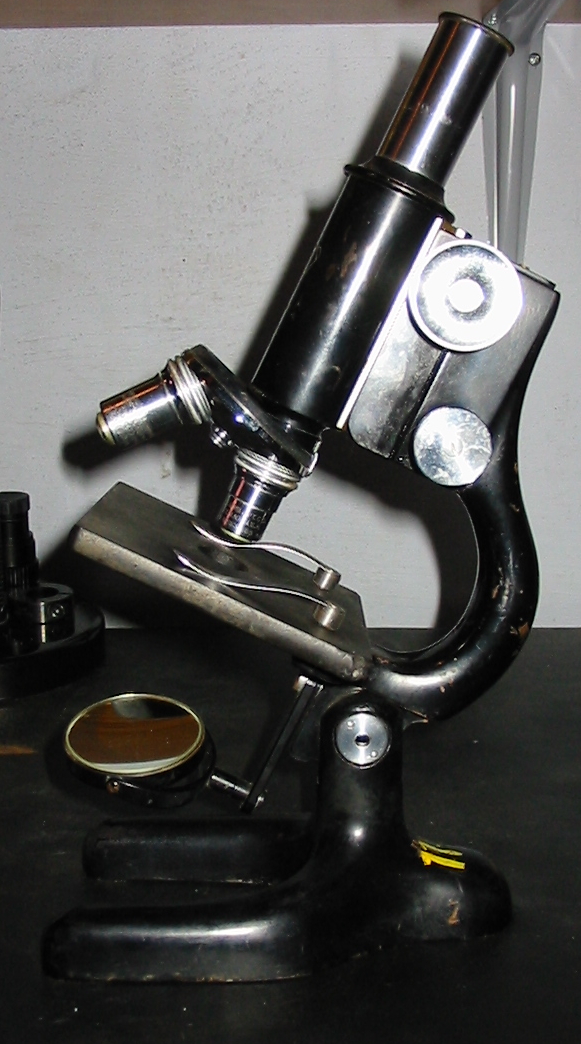
A B&L student microscope, as fine a stand as one needs for routine use.

As fine a stand as one needs for routine use.

Its Character

A student microscope is generally simple, rugged, and basic. Where a more advanced stand will have stops and set screws, adjustments upon adjustments, and provision for all manner of accessories, a student microscope will be without. The photograph today shows a representative microscope of the type by Bausch & Lomb which dates to approximately 1930, this particular example saw service at the University of Kentucky school of zoology.

It has the usual things, coarse and fine focus, rotating nose piece with RMS threads, stage with stage clips, inclination joint, rotating circular substage diaphragm, and mirror reflector. At first glance except for the absence of a substage condenser one might be forgiven for taking it as fully as complex as any microscope of the period. However, a brief look shows that this is not the case. The substage mirror is only single sided, and that single side is the a secondary concave reflector. A moment of manipulation will show that the mirror is mounted an arm and post with no positioning stop to provide confirmation of when the arm or mirror are aligned vertically.

There is no provision for the use of filters between the light source and the object. No mechanical stage is present and as a result of construction one can not be conveniently attached. The stage itself, and the microscopes foot are sure to seem small to those accustomed to more contemporary stands, and it is on the smaller side as microscopes go when compared to more advanced stands from the same period.

Its simplicity

Unlike even moderately more advanced stands, the fine adjustment has no provision for measurement. Where a more costly stand will show markings on its fine focus so that a specimens or structures thickness may be measured in divisions of a few microns or less, on the student stand there is only bare metal. One might think this is done to save time in manufacture, a graduated knob surely taking longer and costing more to produce, but it is more complex (or rather less). The fine focus on a more advanced microscope is graduated as a feature, because it can be. It is constructed in such a way that from its lowest to highest limit a a turn of the knob of a given distance will result in a consistent amount of upwards or downwards focus. A student microscope will often show a variation in its vertical travel as one moves through the range covered by its fine focus.

Without a substage condenser there is no reason for a complex external illuminator. Most students misuse both condenser and illuminator even under the watchful gaze of their teacher so doing away with both is as much a matter of efficacy as it is of economy. The rotating diaphragm is mechanically very simple and prevents as much as it may the abuse of the diaphragm to control light intensity as well. Without a condenser the concave mirror alone will serve effectively for the provided objectives.

Only two objectives are apt to be present on a student stand. The powerful 43x will operate at the limits of its ability with the mirror and a properly positioned light source. The 10x is likely to be one of the divisible sort that may have its front lens removed so the base may serve as a 32mm objective. Once chief characteristic of proper student microscopes (worlds apart from toy microscopes) is standardization. The objectives on this economical Bausch & Lomb unit are identical to the standard compliment of achromats provided on much more expensive models. The oculars as well are identical to the usual Huygenian sort although, only the 10x is apt to come standard. An educator might have easily purchased a number of 5x, 12.5x, a set of wide field oculars, or a few filar micrometers to share out among a class as required. Todays user might easily find replacements for damaged optics or a variety of oculars to suit their needs.

Its Ability

One might expect that an elementary microscope will only provide passable images. As the objectives and oculars are identical to those of much more advanced microscopes, and complex substages are often operated such as to be useless, there is no reason to achieve less than excellent results with a simple, economical§, students microscope. Given the choice of a students microscope from the 1930’s and a students microscope from today one will find the vintage microscope fully as capable and more deserving of ones time.

A contemporary students microscope is apt to be targeted in its selling points not towards the institution, but rather the inquisitive student themselves or more likely the students well intentioned parent. This has led to a focus on magnification as a selling point and a certain degree of complexity being mistaken for capacity. One will find microscopes offered for student use with three and even four objectives, two and three oculars included outright, complex substages and “focusable” LED illumination.

With fewer optics to choose from one is limited in their choices for magnification, and far more likely to make the correct choice. In have a less complex microscope one has perhaps less opportunity to get into bad habits and certainly less capacity to decrease the quality of the image formed by improper disposition of the instrument. At the simplest a students stand should be able to immediately form an intriguing image for the user. With this old soldier one need only turn on a desk lamp, position the mirror to direct a cone of light through the stage, place a slip under the clips, and (due time taken to perform the microscopist’s obeisance) turning the focus knobs bring something interesting into view.

In a moment a world can be revealed, shown with fully as much clarity as any microscope apt to find itself in a students hand. The work that has been accomplished on such microscopes would stagger in its scope and quality. A simple compound microscope suitable for common use in all but the most exacting applications, the classic students microscope is as useful today as it has ever been.

Notes:

∗Secondary reflectors are much more common than primary reflectors. On a secondary reflector one reflecting surface is covered over by a second (generally far less) reflective surface. A polished metal mirror is a primary reflector, a reflective surface covered by glass is a secondary reflector. Secondary reflectors are inherently imperfect and may result in a ghostly secondary reflection in the image plane.

†The size of the stage and foot will not seem out of place to those familiar with microscopes from the turn of the century. The trend towards larger stages and very large footprints is considerably recent as far as microscope evolution goes.

‡It is not very uncommon to find a microscope of over well over one hundred years age the fine focus of which is as tight and responsive as the best microscopes of today. Many different fine focus mechanisms exist and the best of them are simple (comparatively speaking) and reliable in a way that compares favorably to those of today. They might not impress a watchmaker, but any machinist will find them beautifully constructed.

§In this post I switch at times when writing, between how the microscope might have been employed when new, and how it might be used today. When I describe it as economical it applies both to when it was new and even more so to its value now. The microscope pictured cost me less than twenty (US) dollars and is not some rare and seldom available specimen. In the right hands a microscope of this sort will provide results consistently superior to a modern entry level microscope that commands a price ten times higher.

‖Never mind the correct or most suitable magnification for owns aims, one is apt to spend far more time looking at things and far less time twirling the nosepiece about like a maniac. I see “student” microscopes offering 40-1000x 40-2000x and want to have these charlatans arrested! But then what was I saying about maniacs?

¶A modern student might be troubled first by the hunt for appropriate batteries or power cords, potentially difficult to obtain replacement bulbs and even electrical adapters. With the lighting secured but before placing a slide upon the stage, they must puzzle out the usage of the stage clips; as those on modern stands seem to have been designed by persons with no knowledge as to how they are employed! Then the proper objective and eyepiece must be determined or as is far more likely chosen at random. By this time if interest has not waned they must fiddle about and focus and image that is apt to prove far to highly magnified for their use (beginners have a not unexpected tendency to select powerful magnification initially) and will likely mangle a good many covers and slides in discovering how short the working distance of a high power objective is.

The Classic Blood Smear

Blood smears can be fun, but be safe and sterile! -K

Assemble everything required whether only the most basic slide is being made or a more complex preparation. It’s always a good idea to begin with the required materials and a clean work area.

  1. Use a sterile lancet to procure two drops of blood from ones own, or a volunteers, (alcohol swabbed) finger tip. Discard the first drop and place the second on a very clean slip.
  2. With a second slip pull a smear on the first slip.
  3. Dry and fix the smear by ones preferred method. It’s simplest to grip the slide firmly and wave it about until dry.
  4. Stain the smear with ones preferred stain. For Wright’s stain: a. Drop on stain solution to cover the smear and leave for minimum of two minutes. b. Drop on an equal volume of distilled water and leave in place until a greenish scum forms on the surface (1-4 additional minutes). c. Rinse with a few more drops of distilled water. d. Dry in air, do not blot.
  5. If desired mount under a coverslip with neutral balsam or green euparal.
  6. Clean, label, and store slide.

Now for a few notes:

If you have trouble getting a suitable amount of blood try using a larger gauge lancet. A common 33 gauge lancet is very narrow and might not be successful for some people, but a 10 gauge (most common size for Unistik spring loaded lancets) might be too painful for others. A 28 gauge is apt to be more universally acceptable.

When pulling the smear one may find that by holding the second slip at a shallower or steeper angle the thickness of the smear can be controlled in a limited way. The speed at which the smear is made also has some effect on thickness. Try to maintain a consistent speed every time but don’t be afraid to experiment to find the angle that is most successful at ones own speed.

Do not try to fix with any substance (except for some methods of vapor fixation) before the smear has been dried, it will come off, the smear will be ruined. If one is working with a large number of smear it may be better to dry and fix in an oven.

Stains are available in many forms. Even something as common Wright’s stain may be found in a one step buffered solution, as a more traditional un-buffered preparation, or a powder. The directions above will give acceptable results with a buffered or un-buffered solution. When provided, follow the manufacturers directions for the stain used. Additionally, remember that all stains have a shelf life. Most solutions of Wright’s will only work their best after seasoning for a few weeks, and lose their potency after eighteen months.

A stain like Wright’s will bleach out somewhat in an acid mountant. It is therefore advisable to use an ostensibly neutral mountant like euparal or green euparal (which retains stain brilliance better than regular euparal). Alternatively one might keep a few pieces of marble in their balsam bottle to cut down on its acidity.

Depending on the size of the smear one may find a certain need for longer than average coverslips. 22x50mm and 22x35mm covers are widely available but one may also use a smaller cover that only covers a portion of the smear. In any case one should take the time to clean the area not covered after the mountant had cured.

There’s a great deal more to the microscopy of blood and for many people a simple smear can get dull quickly. However, it’s still an important skill and covers many of the various aspects of mounting in a way that can be moved through rapidly in just a few minutes. It’s useful also as a demonstration of the importance of specimen preparation as even an unstained smear will show more than a simple drop of blood under a coverslip. -K

More Blood!

Not done yet, this is just how to make the smear. -K

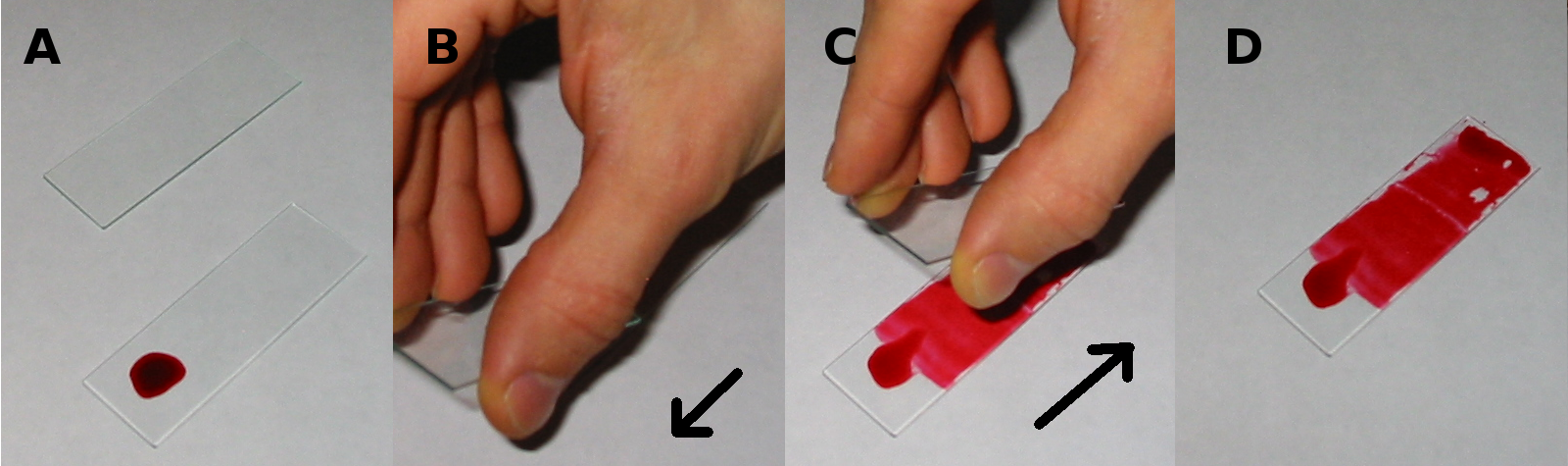
There are more than a few methods for making smears in general, and a couple for making blood smears specifically. By far the most generally useful method, and the easiest, is what I refer to as pulling a smear. In pulling a smear one may produce a large, thin, and even smear that is rather more uniform and consistent than that which might be produced by other methods. It’s very easy for beginners to read the method and then  perform the action incorrectly, so please observe the pictures and practice with a bit of fountain pen ink or food coloring before getting set to make the smear with blood.

Practice the method with ink before working with blood.

Practice the method with ink before working with blood.

In A we see a drop of blood (in this case ink for practice) placed near one end of a slip. In B a second slip has been placed on the first at an acute angle. The second slip is then slowly pushed back until it comes into contact with the blood. Once contact is made the blood will spread out along the line the edge of the second slip. Maintain firm and even contact with the slips. The blood should remain primarily on the side next to the drop; within the acute angle. As in C, the second slip is then drawn in a smooth even motion along the first so that the blood is pulled along leaving behind an suitable smear. In D care was made to produce some of the more common troubles. Midway along the smear a lighter line is observed where the slip was stopped as it was drawn along. Further along we observe two blank areas where the slip was allowed to lose contact at the lower edge.

In the above image the camera is positioned at six o’clock, and I am seated at three o’clock. Most depictions of the process provide the impression that smears are best drawn along a horizontal from left to right (or right to left). It is easiest to ensure a smooth motion (for those who are right handed) to pull the smear from from eleven o’clock towards four o’clock.  When pulling along a perfect horizontal it is more difficult to keep constant contact and pressure along the entire length of the smear. It is in some respects a matter of preference but above all do not make the common mistake of drawing over the drop or of positioning the second slip so that the drop of blood spreads out in the obtuse angle side of the arrangement.

Apart from everything else, it’s very important to form the smear on only the cleanest of slips. Oil, dust or other imperfections can prevent the smear from adhering properly once made, or from being made effectively in the first place. Always take a moment to exhale on even a clean slip prior to beginning. If the vapor of ones breath forms an even cloud upon the slip, and it dissipates rapidly it is likely to provide good results.

With the smear made it must be fixed. One may fix via heat or chemical methods but for blood smears it is often better to simply wave the slide about rapidly (with a firm grip of course) until the smear is dry. Microbiologists are apt to follow Ehrlich and place the slide on a hotplate or in a cool oven for hours on end, but such efforts are not generally practical when only a few slides are being produced. If one desires to employ chemical fixation, the film must first be adhered to the slip and the primary method for that is… waving the slide about rapidly! Because the cells in the blood smear will retain the shape when dried, it is best to forgo complex fixation and stick with that tried and true method, regardless of how indecorous it seems.

After fixation the smear may be examined immediately, with or without further treatment (even with oil immersion). Or it may be stained to improve its appearance. One my use a popular traditional stain such as Wright’s or whatever is on hand. In the next post we’ll cover the use of Wright’s, but one may wish to try the stains they are familiar with. Methylene blue is a widely available stain that will make leukocytes much more noticeable.

Blood And…

Please refer to first image in the previous post for clarity. -K

Where can blood smears be acquired?

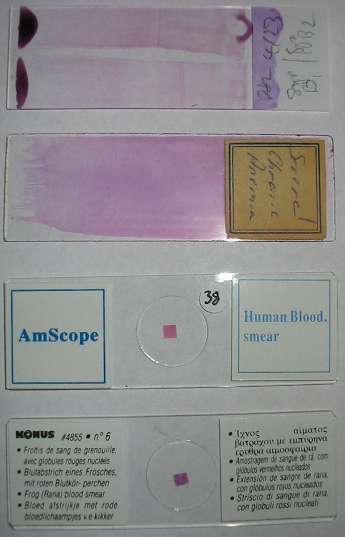
The first two slides were purchased as part of larger collections from a student cleaning house in the first instance, and a collector in the second. If one wishes similar specimens know that they are generally not on the expensive side (as far as prepared slides go) and available wherever second-hand goods of a curious sort may be had. The second two slides and others of similar sort are available singly, or as components of general sets from dealers in educational materials. Without being too indirect let me just comment that Carolina is an excellent source if one elects to purchase commercially prepared slides of considerable quality.

As an obvious alternative, one may produce blood smears of their own without excessive trouble or exotic materials. A few slips, a stain or two and a pin are the bare minimum of supplies required. Unfortunately, things get tricky here. Blood smears are usually produced for a particular diagnostic purpose, and although they may be safely made by an amateur, it’s a medical procedure and can present some hazards. One may hardly rush about pricking friends and family with a pin for the sake a few drops of blood and a bit of curiosity. Blood-borne pathogens are very real and potentially dangerous, so that pin mentioned above is right out.

What is needed to make one?

Toss out that pin and replace it with a sterile lancet. Pharmacies provide an extensive selection of disposable lancets and reusable lancing devices for diabetics. One can purchase a box of one hundred single use sterile lancets for a few dollars and a compatible variable depth lancing pen for a few more. Spring-loaded disposable lancets are an option as well but might not be as readily available.

Any two slips of the traditional one by three inch size may be used. It is often best to select high quality slips of one millimeter thickness however, cleanliness is the most important factor for success with smears; fine smears may be made on the cheapest economy slips, provided they are clean. It’s worth noting that although the smear may be made upon any slip it is most easily produced when using a slip with plain cut edges, beveled or ground edged slips may be used but are apt to result in difficulty.

Cover slips are not absolutely necessary, but if desired one should use the largest possible and ensure all are of a thickness for which ones objectives are corrected. It may occasionally be best to form the smear directly on the cover slip and in that case one should avoid circular covers.

If employing a cover slip one will need a mountant. Any of the standard permanent mounting mediums will do. For most users this will mean Euparal or Balsam. When using balsam it should be as neutral in pH as possible as acidity will tend to bleach the stains more or less rapidly. Histomount, Mount-Quick, SHUR/mount, Meltmount, and any other of the modern permanent mountants may be used with only slight modification to the smear preparation as required.

Stains are a must when it comes to blood smears. Wright’s stain is perhaps the most popular, followed by hematoxylin and eosin (H&E). Depending on the supply of stain one already has on hand it is possible to prepare a suitably stained preparation with any of numerous combinations. Eosin and methylene blue may be used individually to produce an effect identical to that of Wright’s stain (which is of course a combination of eosin and methylene blue in methyl-alcohol). Giemsa, on its own or in conjunction with Wright’s is a popular option as well. It is always possible to try whatever is on hand provided one is familiar with its action.

What else is needed?

Nothing, nothing else is absolutely needed. At it’s most basic one needs only two slips, a drop of blood, a bit of stain, and access to running water. The next step beyond requires only the addition of a cover slip and mountant. Different sources might lead one to believe that a host of other supplies are required. Access to a Bunsen burner or hot plate is frequently required in historic methods, notably the Ehrlich method. A dozen Coplin jars and different solutions for each might be called for in others. One might be directed to add normal saline or buffer solutions to the smear while staining. Some works see fit to recommend methyl-alcohol as a fixative or drying bath.

All the extras are really just that, extra. While specialized methods are recommended for particular needs, all the extras are truly superfluous for smears intended only for general examination. If one happens to have other materials on hand and wishes to employ them effectively the points at which they come into play will be mentioned when the process is explained in the next posting. It is no great loss if only the basics are employed.

The bare minimum for a blood smear.

The bare minimum for a blood smear.

Next time: making the smear!

Blood

I’ve been putting it off but… let’s have a look at blood smears. -K

What are Blood Smears?

Blood smears are the sort of slide most people imagine when asked to think of a specimen for microscopy. They are thin, generally well-stained, films of blood secured to slips for observation under high power. Such slides also happen to be among the most commonly produced slides on earth. Medical practitioners all over the world, be they in state of the art laboratories or primitive field collection sites produce countless blood smears annually while working to diagnose and treat profoundly diverse diseases. To drive home their abundance; I’ve nearly one thousand smears provided by a student who produced them all while working on a single research project. There was a time when blood smears were routinely used in biology classrooms to introduce microscopy and cellular anatomy to students from grade school through to university, but concerns for safety left blood smears by the wayside and educators began to focus on onion skins and relied on ready made smears.

A variety of blood smears.

A variety of blood smears.

At left one may observe a variety of blood smears. The top is a double smear of blood from a laboratory mouse that was made as part of a study relating to malaria vaccination. Bellow that is a human blood smear that was used as a representative example of sever chronic anemia for diagnostic comparison as part of hospitals hematology lab collection. The final two slides are representative of modern, mass-produced slides of the sort one might find in a young students biology classroom or a popular science store. Differences among the slides are immediately obvious. One might consider that all the slides are utilitarian; constructed for particular purposes to which they are well suited.

The first two present an observable area of considerable size, such that a range of structures may be found in quantity. Large smears allow one to consider the percentages of the various types of leukocytes, for example. The size of the smear likewise ensures that some portion of it is apt to be of optimum thickness. Additionally neither of the first two slides is furnished with a cover slip. While this makes the smears rather more vulnerable, it also permits the use of very high power, high numerical aperture immersion objectives with exceptionally limited working distance.

The second two slides feature comparatively limited area for observation. What material is available for observation is insufficient to provide much for study but is instead exhibits a representative specimen, uniform, and secure beneath a cover slip. Making use of such a limited portion of the slip permits the slides to be used on microscopes lacking mechanical stages and relying instead on simple stage clips for securing the slide. Stage clips would severely damage the smears on either of the first two slides. Struck by the curious rectilinear outline of the smear in the second two slides, one might not be surprised to know their smears are actually cut from a sheet and then mounted as a transparent object. Mechanically neither of the bottom two slides is suitable for oil immersion work. However, they are widely available, inexpensive, and sturdy enough for prolonged use in a classroom setting.

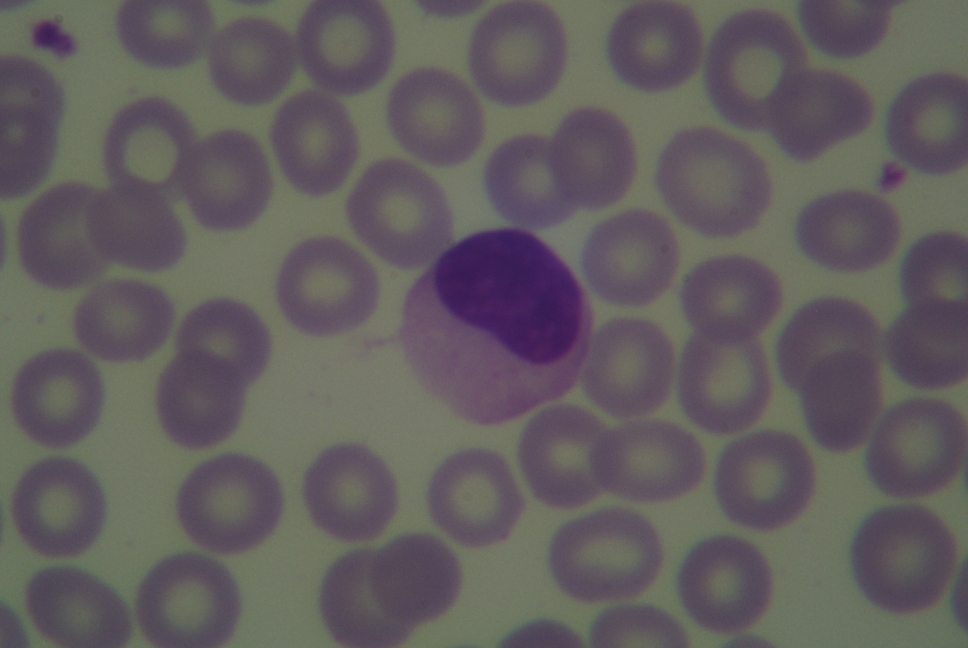
If your kisses can't hold the man you love... mononucleosis will!

If your kisses can’t hold the man you love… mononucleosis will!

More on blood smears next time! I have got to stop being so long-winded… -K