Clearing and Mounting

The next bit is rather simple compared to everything previous but does require a bit more dexterity. It is important to remember that not all the specimens that have reached this step will come out unscathed. In fact, some specimens might not be suitable because they have been damaged in those earlier steps! Ever heard some tough walking cliché say “pain is weakness leaving the body”? Well friends, failure is just experience entering the body. Believe me, if I can do this, so can you.

At this point one should have a container of alcohol (denatured is fine provided it’s 95% or better) with specimens inside held together between two slips. During their time in the alcohol the water in the specimens has been dehydrated out by the alcohol. After having been used a number of times (more or less depending on the initial quantity of the alcohol and size and number of the specimens) the small amount of water present in the specimens will be enough to dilute the alcohol noticeably and it should be retained for other uses that require less complete dehydration.

One might be aware that besides dehydration alcohol will act as a hardener on many organic substances, chitin among them. Ardent hikers should know the old trick of preventing blisters by hardening the souls of ones feet with rubbing alcohol before a big hike. The hardening effect of alcohol will ensure that our specimens remain in shape for mounting, but it will also make them quite brittle. Avoid the temptation to rush and be careful as possible in the upcoming steps.

With a large watch glass or Syracuse glass on the table, and a wash bottle or pipette of alcohol at hand, remove one set of slips from the container of alcohol. Slowly remove the clips holding the slips together and separate them a small amount by sliding one or the other slip away. Resist the urge to lift the slips apart as an antenna or leg might more easily break off with that motion. Once the slips are slid apart a small amount it should become apparent that the specimen is more affixed to one slip than the other. Work with the slip to which the specimen is most attached at the bottom so that the specimen is facing upwards and keep the specimen wet with alcohol while gradually sliding the other slip away.

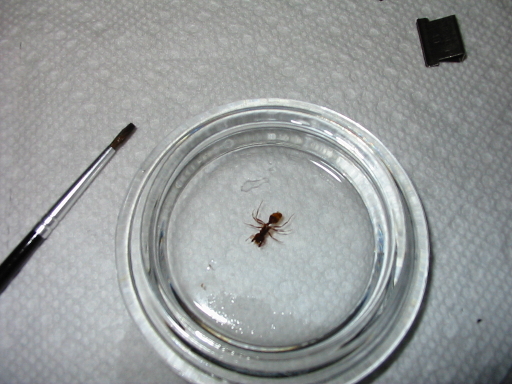
Once the top slip has been removed use a stream of alcohol from a wash bottle or pipette to rinse the specimen into the watch glass. With the specimen in the watch glass give it a quick look with a hand lens or dissecting microscope to see if any debris is clinging to it. Use a camel hair brush, fine needle, or eyelash to remove any debris from the specimen. If only a few specimens are being processed they may all be washed into the same watch glass before proceeding, or one may wish to finish each specimen before beginning the next. The choice largely depends on how much space is available in which to work, but I prefer to move each specimen though the process one at a time.
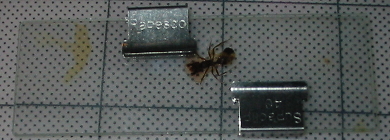
Image

An ant washed into a Syracuse glass for cleaning

If the specimen has been macerated too long, not long enough, or has been otherwise damaged it should be obvious at this point. Whether or not to continue with a damaged or poorly treated specimen is up to the microscopist. An ant that has broken off legs or antennae, or one that is falling apart from too long a maceration can still make a serviceable mount. If the abdomen has been disintegrated (as sometimes happens when macerated too long) consider mounting only the head, mouth parts, antennae, or legs. If the specimen is clearly too thick or still retains its internal organs one can wash it in water and return it to the macerating solution, or start anew with a fresh specimen. Whatever the case, keep written notes on the quality of the specimen had at this point, as it relates to the operations performed on it. It’s one thing to read someones account saying a day or two of macerating is sufficient and something else entirely to know from experience that 48 hours of macerating is too much for one specimen and not enough for an other.

Once satisfied that the specimen is free of debris it must be cleared. Clearing is a simple operation in which the fluid of the specimen is replaced with one which is miscible in the mounting medium to be used. If working with Euparal for instance the clearer used would be Euparal essence or even simple the purest most anhydrous alcohol available. With Canada Balsam (sometimes called xylol Balsam, neutral Balsam, fir Balsam or simply Balsam) one has their choice of clearers, the one selected being largely a matter or preference the procedure is the same whichever is used. Three of the most popular and readily available clearing agents for Balsam are turpentine, xylene, and Clove oil. Of the three Clove oil is the safest to work with (though it is also more expensive and harder to find than either turpentine or xylene) and it is worth noting it has the least offensive scent.

With a fair amount of clearer in a small jar close at hand, remove the specimen from the watch glass using a section lifter, dry camel hair brush, fine forceps or whatever is convenient. Once lifted from the watch glass allow as much alcohol as possible to flow from the specimen without its drying out completely. A small corner of filter paper can be touched to large specimens if necessary. Place the specimen into the jar of clearer. The amount of time required for the clearing agent to penetrate the specimen is dependent on its size and just how well macerated it is. I find that 24 hours is nearly always enough time but have used as little as one or two hours in the past.

Image

Ant in clearer with section lifter and centering card

After 24 hours the clearer should have penetrated the specimen entirely and replaced the alcohol that was used to dehydrate the specimen. If xylene was used as the clearer and it was observed to become milky when the specimen was placed into it then specimen was not fully dehydrated and should be placed into pure alcohol for an hour or so then put into a new dish of clearer. With a fresh and scrupulously clean slide laid out on a centering card the specimen should be removed from the clearer and laid out as desired. It will not be quite so brittle as it was after being taken from alcohol but one must still be exceedingly careful with the delicate appendages.

With the specimen centered on the slide take a small corner of filter paper and leach away any excess clearer clinging to the slide without removing that which wets the specimen. At this stage I find that Clove oil is not only the best smelling clearer but the most forgiving. It will not evaporate nearly as fast as turpentine or xylene and provides some valuable extra time with which to ensure that the specimen is positioned properly. Unfortunately, this also means that specimens produced with Clove oil as the clearer will also require a longer curing period.

Cover slip placement is often treated as a matter of preference but I vigorously oppose that notion. For particular styles of mounting, particular methods of cover slip placement are undoubtedly superior. The best method is however that with which the mounter is able to achieve the best results. In the case of pressed and macerated insect mounts it is easiest to place a drop of mountant on the cover slip and then lower it directly onto the specimen. This method does the most to prevent displacement of the specimen and is the method by which the amount of mountant used is best gauged, an invaluable asses to the novice. One large drop or two small drops from a slender glass rod is about right for most specimens the size of a harvester ant.

Once the cover slip is set one may chose to apply a small amount of pressure with the eraser end of a pencil or a camel hair brush but its not often necessary. Any excess mountant exuded may me cleaned up with bit of filter paper, but take care not to disturb the cover slip. The slide may now be placed in a cool oven or incubator (if one is available) for a few hours to cure. The time required for curing depends on the mountant and clearer used as well as the temperature. If time is of the essence the slide may be warmed over a spirit lamp or Bunsen burner to hasten things along, but superior results are often achieved by simply placing the slide in a case of some sort to keep the dust off and putting it on a shelf or a hot summer time attic for a few weeks. At room temperature a natural Balsam mount with Clove oil clearer can take as long as two months to cure.

Don’t be discouraged by the waiting time, the longer the period which is available for curing the more opportunity there is for any bubbles in the mountant to work their way out. In some up coming posts I’ll write about putting together a simple slide dryer and ringing a mount of this sort, but for now here’s an ant thats been produced over the course of these blog entries:

Image

Note the air bubble to the right of the lower antenna, and how unconcerned I am about it
New Year, Next Step

Happy new year! How appropriate that today begins a new step in the preparation of a whole insect mounted with pressure. The previous step was maceration and some specimens will always macerate faster or slower than others. Seeing as I must return to work tomorrow I decided to move things along today, even though one specimen appeared unready.

Image

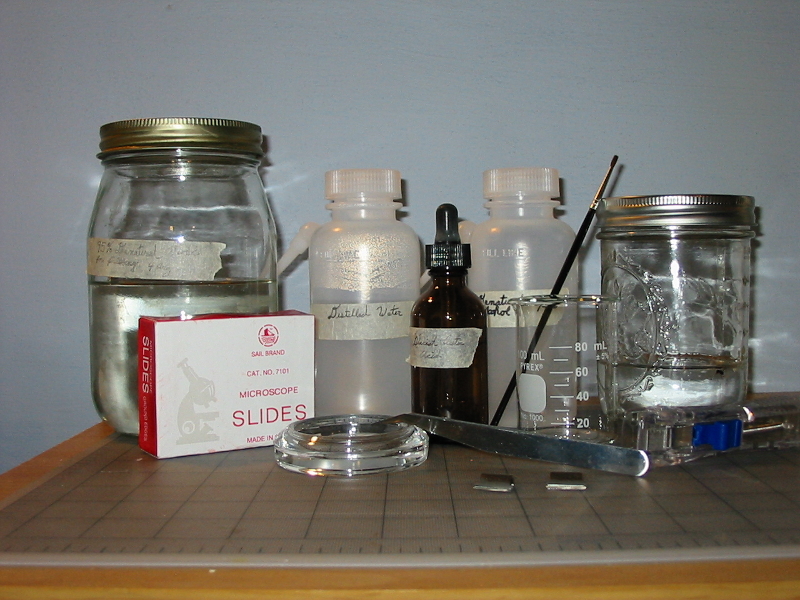
Todays supplies

After the (Chemical) Fire

No there hasn’t been an accident, but after just over fifty hours of macerating the ants may appear as though there has been. When they were initially placed in the macerating solution each ant was quite buoyant, floating on the surface of the liquid. Withing twenty-four hours small bubbles were in evidence on the surface of their abdomens and they were noticeably less so. In the early evening of yesterday one of the ants was observed to be exhibiting neutral buoyancy. This morning it was resting on the bottom of the macerating jar with its abdomen appearing markedly lighter in color than the other. Enough time was felt to have passed for the next stage of slide preparation to begin on the sunken ant at least. Operations were carried out on each in any case.

Until today every activity performed on the specimens has consisted of nothing more than placing them in some container of liquid and waiting. At first today will prove no different. The ants will be transfered to an empty container and washed of the macerating solution. After this, any remaining traces of the macerating solution will be neutralized chemically. Finally the specimens will be pressed, dehydrated, and hardened.

A Wash and a Brush Up

Remove the macerated specimens to a small container. I find that a low profile beaker is best but any small container with a spout will prove convenient. Once the specimens are in the empty container pour over them a quantity of distilled water and leave them for not less than fifteen minutes. After fifteen minutes pour off and replenish the water. This activity may be carried out more or less extensively depending on the preparers confidence in ridding the specimens absolutely of the macerating solution.

Some mounters (among them R. M. Allen in his manual The Microscope) recommend performing the process of washing over the course of several hours. It is also possible to hasten the procedure by washing in the more cursory way described above provided an acid is used to ensure the absence of any Sodium Hydroxide after washing. I have read in one account or an other that after removal from the macerating solution the specimens may be washed and placed into a vessel of concentrated acetic acid and left indefinitely. I have never done so personally, I may post about the effect if I ever do.

After the second wash the ants were removed to a Syracuse glass of distilled water. Once there they were lightly spread with a camels hair brush to remove them from the posture they had taken after killing, five drops of glacial acetic acid was introduced to the Syracuse glass. For particularly bulbous insects the abdomen may be pressed gently with a camels hair brush while in the Syracuse glass. This will discharge the liquefied organs and help to make the following step easier. For the small ants I used this was not warranted.

Layout and Pressure

Put out two clean glass slips for each specimen, these will be used to apply the pressure needed to flatten the subject for mounting later. With four slips on the table, one need not use expensive slips of first rate quality provided only that they are clean, remove one ant to the center of one slide and using a corner of blotter paper draw off as much liquid from around the specimen as is possible without drying it entirely. Removing the liquid is not essential, but will help to ease the process of arranging the specimen.

With a clean camels hair brush and fine pair of forceps (or fine, blunted, dissecting needle) arrange the ant as desired on the slip. Care should be taken to extend the antennae, mouth parts, legs, or any portion which is of interest. One should act quickly so that the specimen is never permitted to dry out completely. Once satisfied with the arrangement lower a second slip onto the first so that the head contacts the lowered slip first and the edges of each line up. Carefully apply pressure while maintaining the alignment, failure to do so (lateral movement of either slip) may tear specimen.

Once the slips are as close to each other as careful pressure with the hand permits the slips must be bound together. An assistant could tie a short length of strong thread around either end of the slips, or any number of a variety of spring clips may be applied. Clothes pins may be used but they are quite bulky. The traditional binder clip is superior but one must search out a supply that is composed entirely of plain metal.

Image

A specimen pressed between slips for placement in alcohol

Hard and Dry

As soon as the slips are bound together they are placed into a vessel of alcohol sufficiently large and full that the entire slip is submerged. The alcohol should be not less than 90% pure, but denatured alcohol is perfectly acceptable. Two things will be accomplished by the alcohol in this step; the specimen will be dehydrated, and its tissues will be hardened in its flattened condition.

Once in the alcohol the specimens must be left for a period of time that is largely dependent on their size. Allen describes the required time only as “short” and I will not hazard a guess as to the unit of time that best describes. I can say that the slips may be left in the alcohol until it is convenient to carry on. I have left harvester ants pressed as described above in alcohol for as short as three hours and as long as twenty-five without noticing any difference.

Next time, things finally become clear!

Maceration

Be careful and nobody gets hurt. It’s great advice but seriously if one does not feel confident in performing the following operation safely then by all means do not build your confidence with this exercise! Chemical burns are not the sort of thing one experiences lightly. However, common sense and some basic protective equipment are all that’s necessary, more about that below.

Supplies for preparing the macerating solution.

Supplies for preparing the macerating solution, etc.

What, Why, and How

Continuing on with the previous slide prep, at this point a quantity of specimens should have been aquired. It’s unimportant if they are in alcohol as the preceding post describes or dry. It’s assumed that some manner of ant (order Hymenoptera) or spider (order Araneae) has been collected and it will be required. In order to prepare a pressed insect (even if spiders are no insect I trust the simplicity of writing as such will be forgiven) one must first do something about all the bits and pieces inside it’s chitinous skeleton. Secondly, the chitin will need to be acted upon to soften it so that it may be made to fit under a cover-glass, thirdly it will need to be rendered a bit more transparent so that the microscope may be used as with a transparent object.

The process by which these three operations occur is called maceration. During maceration soft tissues (proteins, fats, and nearly everything else organic) undergo a process of chemical decomposition. The organs will be liquefied and the chitin itself softened and somewhat bleached. If one observes a specimen of Hymenoptera post maceration it will be seen that the chitinous plates of its abdomen will be somewhat separated at their joints. The specimen as a whole will exhibit a noticeably flabby appearance and be quite pliable. This is a good thing, don’t worry.

Maceration can be performed by any number of operations but the simplest is by the use of a strong base in 10% solution with distilled water. Of the bases Potassium Hydroxide (caustic potash, potash lye, KOH etc.) and Sodium Hydroxide (caustic soda, lye, NaOH etc.) are the most frequently employed. Each has it’s particular merits but Sodium Hydroxide is somewhat more forgiving in its action on the specimens and is generally more widely available. For our purposes the differences between the two are inconsequential so one is free to employ whichever is available.

One can order the chemical from a reputable supplier online without any great difficulty or expense. It may also be found at a well stocked hardware or grocery, often in the plumbing isle. Each is likely to be available as a liquid of varying concentrations, or a solid in flakes or pellets. The pure, pelleted solid is perhaps the best choice and easiest to work with.

Safety; or, Please Ignore Tyler Durden

Does anyone remember the movie Fight Club? Perhaps the scene where Brad Pitt burns the back of Edward Norton’s hand comes to mind? They were making soap and Sodium Hydroxide just happens to be used in the soap making process. Pitt burned the back of Norton’s hand with lye to make some point about the value of being a masochistic luddite or some such and then proceeded to dump a quantity or vinegar on the site of the burn as treatment once he’d made his point. This is really a terrible idea.

There are two ways a strong base can cause a burn, chemically and physically. Neither is pleasant. The chemical burn is caused by the strong base breaking the bonds of ones very flesh, in essence macerating skin just as we will be macerating the specimens to be mounted. The physical burn is caused by heat. When a strong base is added to a solvent like water, or say the moisture in the cells of human skin, it will separate into its ions (a chemical reaction that causes a chemical burn, but) this is an exothermic reaction that can give off quite a bit of heat. The more totally it separates and the faster it happens the more heat is produced.

Vinegar is a weak acid, lye is a strong base, and water is ideally neutral. If one puts an equal amount of lye into 100 ml of water and 100 ml of vinegar, the lye will separate more completely and much faster in the vinegar. It will give off more heat and not provide the instant relief the film might lead one to expect. Proper first aid for an accidental application of lye in solution (or dry) is water, lots and lots of water, for 15 minutes. Don’t apply vinegar, and don’t take advice on chemistry from movies or blogs on the internet. If there is an accident and some water is applied till it stops hurting, but for less than 15 minutes (until all of the base is neutralized) the chemical reaction will continue and the burn will become worse. Look up the safe handling requirements of Sodium Hydroxide (and any chemical) before handling it if there are any concerns. Wear gloves and goggles and work in a room with immediate access to plenty of running water. Clean up any spills immediately using plenty of water and wash everything used to handle the Sodium Hydroxide throughly.

A final note, the Sodium Hydroxide (or Potassium Hydroxide) is going to come packaged in an air tight container. The chemical inside will be as free from moisture as the packager could make it. When exposed to the air it will absorb some moisture from the air. Seal it tightly to keep it from forming a solid block during storage. When handled it may stick unpleasantly to whatever it contacts either as a result of its extreme dryness or its affinity for moisture. Be careful that no little bits go unnoticed sticking to the underside of this or that. Always add the base to the water, and always add it a little bit at a time. 

Weights and Measures

Mixing up a 10% solution of Sodium Hydroxide is a simple matter. Add one part of Sodium Hydroxide to ten parts of distilled water in a suitable container. What makes a container suitable? Particularly high concentrations of Sodium Hydroxide can etch glass over time. Sodium Hydroxide will also react with some metals such as aluminum. So for a suitable container a tightly sealed plastic jar may serve. However, as 10% is not a particularly high concentration, and many jars used for canning employ stainless steel lids, a wide mouth pint Mason jar or similar is recommended. Clearly label the jar ahead of time so it isn’t forgotten later.

When comparing one part of a dry compound with ten parts of  liquid a common unit of measure will be necessary, in this case mass (though weight will be used if one feels like being technically accurate). Distilled water (in microscopy one should nearly always employ distilled water) has a practical mass of one gram per centimeter cubed. One cubic centimeter just happens to be equivalent to one milliliter. So if one intends to make up approximately 100 ml of 10% Sodium Hydroxide solution, one will need 100 grams of distilled water and 10 grams of Sodium Hydroxide.

Chemistry professors might cringe at the preceding but exact concentration is not really important, it just needs to be in the neighborhood of 10%. Remember, Sodium Hydroxide is a bit more forgiving than Potassium Hydroxide so a concentration varying as much as 5% in either direction is no great failure. Supposing however, a significant textbook of chemistry resides on a nearby book self… one might consult it to find that a 10% concentration of Sodium Hydroxide in water has a density of 1.10890 kg/L at room temperature (1.1089 g/mL). This would mean one should add 11.089 grams of Sodium Hydroxide to 100 ml of distilled water for a 10% solution.

That same textbook will likely describe a number of formula for the calculation of pH. With a digital pH meter or some indicating paper one might measure the pH of the solution produced and work a few equations to determine the final concentration after the solution is mixed. But Molarity and pH calculations are only fun for a special few and all this chemistry is just taking away from time at the optical bench!

In any case measure 100 ml of distilled water into the jar using your graduated cylinder or whatever measure is handy. Then weigh out the proper amount of Sodium Hydroxide on a balance or scale and carefully add it a small amount at a time to the water. If a sensitive enough scale or balance isn’t handy then one should note that two teaspoons of pure pelleted NaOH weighs in at 12.6 g. Add it slowly a little at a time to the water to give the heat of the reaction time to dissipate. It will dissolve slowly and for a time the water will appear quite cloudy. Do not put the lid in place until the solution becomes clear (pressure may build up and burst the container!) which may be some minutes. Cleaning the utensils used to measure is a good activity while one waits for the solution to clear. Do not be alarmed if the jar becomes warm to the touch (it will no matter how slowly the Sodium Hydroxide is added) it will not pose a hazard if due care and time is taken.

Finally

At this point one should be in possession of a 10% solution of a strong base in water, and a quantity of insects in alcohol. Carefully remove the specimens to a dish of water. A long set of forceps wielded carefully is ideal for the operation. I find a set of stainless steel thumb dressing forceps invaluable.  Pour off and replenish this water once or twice to remove the alcohol. Then carefully introduce the specimens to the macerating jar. If working with dried specimens rinse them in distilled water to remove any debris before adding them to the macerating jar. A wash bottle of distilled water and a Syracuse glass makes the operation the work of a moment.

IMG_1119small

Washing the specimens prior to maceration

The time required for maceration is widely variable and dependent on the size and toughness of the specimens. As a general guide to begin with; a period as short as 24 hours will prove sufficient for small, lightly colored ants and spiders. As long as 48 or 72 hours is often required for larger ants (like the black carpenter ants one finds on decks and trees). Trial and error provides a better eye for success than any text so do not be afraid to experiment with different periods of maceration.

When in a hurry the prepared macerating solution can be made more potent or heat my be applied to speed its action on the specimens. Several handbooks recommend boiling the specimen in the solution for a few minutes. Doing so is markedly more hazardous and the savings in time is not worth the added risk. Boiling will not generally produce superior results. If a specimen is possessed of a particularly large abdomen it may be necessary to puncture its underside with a dissecting needle prior to placing it in the macerating jar to ensure the action of the solution on the internal organs.

The next step will be posted after my specimens are prepared for it!

Happy Christmas, I’m Back Again!

After an extensive and decidedly involuntary hiatus some medical issues have been sorted and I once again have the time and energy for that most excellent pursuit. That’s just one of the fantastic things about microscopic mounting, in many of the processes there are several stages at which production can be halted indefinitely and returned to weeks or even years later without ill effect…

The first step in creating a slide of any sort is not often planning as one might think. As an amateur the first step is more apt to be the acquisition of a specimen; formation of a process for mounting can come later. At present macerated and pressed insect slides are the goal and the methods discussed will be limited to those appropriate. Depending on the particular part of the world where one resides this may not be the most opportune time for the collection of specimens but there is always some supply to be found or purchased. For the sake of simplicity in this first attempt at a mount one may stack the deck in their favor by selecting a hardy subject. I heartily recommend ants.

An ant or ten can often be found in any of the seasons save winter (here in New York anyway) diligently trouping across ones sidewalk or patio. Collection is a simple matter and may be accomplished with whatever container is at hand. Specialized apparatus such as a fine set of forceps or an aspirator can speed up collection but are luxuries rather than necessities. In a popular work concerning ants titled Journey to the Ants, eminent myrmecologists Dr. Bert Hölldobler and Dr. E. O. Wilson spend a page or two on the ease of collecting and preserving specimens in the field be it a South American rain forest or at dinner with Stalin: put the ants into alcohol.

One can use whatever spirit is handy and potent. Concentrations of 80-95% isoproply or denatured alcohol being common and inexpensive make them useful. For our purposes the alcohol acts as killing agent, fixative, and preservative. Live specimens collected directly into a container of alcohol may be stored indefinitely for use as required or removed and desiccated for traditional pin mounting as desired. If one is unable to readily capture ants locally for whatever reason the various retailers who sell ant farms will happily supply a vial of harvester ants for a few dollars delivered.

It’s useful to note that ants aren’t the only subjects which are generally collected directly into strong alcohol. If hunting in the field one happens on an intriguing arachnid Comstock’s classic work The Spider Book recommends collecting into small killing jars or even directly into the strongest alcohol available. The alcohol being decanted and replenished the following day to ensure its potency after the spiders own moistures dilute it.

Spiders and ants make exceptional first specimens as their lack of wings and significant exoskeletons greatly simplifies their processing. That one is generally able to locate several of the same species also helps to ensure that an acceptable slide may be produced. With a significant stock in alcohol on the laboratory shelf one is free to attempt many variations of method to produce the finest results. So do run out and start collecting, or get your ants on order. When I return we’ll begin mounting in earnest, why not come along with me?

Pressed Insects

Image

The above photo is of three older microscope slides I picked up via eBay for a few dollars. Whole mounts of this sort were once a lucrative business for optical and biological supply houses, and a thriving area of pursuit for hobbyists producing slides of their own. Inarguably, preparations of this sort are very striking under the microscope or even with the naked eye. They are also frequently criticized. Some entomologists, even some microscopists, both today and in the impressive body of historical microscopy and etymology literature, positively railed against slides of this sort. For some, the only proper way to mount insects or arachnids will always be on pin under glass. Why all the hate?; Maceration and pressure.

In order to mount an insect (or anything for that matter) on a slide there are really only two options; incredible thinness or a cell of appropriate thickness, and we wont be dealing with cells today. Some insects (or portions of them) are of a size that may be mounted intact without a cell, however, for the majority that is not the case and the specimen must first be somehow processed. For slides like the above, that processing involves removing all but the chitinous exterior of the specimen, rendering that chitinous skeleton pliable, flattening it so that no cell is needed, and rendering the specimen transparent. Doing so necessarily renders the specimen quite different from its natural state which can lead to false conclusions regarding the species, especially among amateurs.

While the scientific value of slides like the above is debatable, their appeal is undeniable. Some modern slides like the above are available, but they are generally no where near as plentiful, or as well prepared as they were fifty or more years ago. So, is the present day microscopical hobbyist limited to the dozen or so species that may be found from the modern suppliers or what may be scrounged up second hand? Of course not! With a few rather common supplies and a bit of patience one can produce pressure mounted insect slides of their own. After all, I’ve done it with perfectly passable results; and believe me, if I can do it, so can you.

In the next few posts I’ll be going through the process from collection to completion and pointing the way to some classic works that provide much more exacting procedure than I. 

Times, Diameters, and Public Domain Books!

A big part of what I do with the microscope comes directly out of books. I have no formal training with the microscope so books dealing with it usually contain something that I was totally unaware of, or just provide a solid footing. Occasionally they clear up misconceptions, which happed just this morning actually.

Microscope objectives are designated in many ways, but chief among them is by their magnification. Unfortunately for the beginner, there is more than one way to describe the magnification of an objective. For quite a long time objectives (and oculars) were described and marketed primarily by their focal length. They might also be described by the times they magnify an image, (as in 10x, 40x, 100x) or by the diameters of magnification they provide; a way that until recently I thought synonymous with the times designation.

The focal length of an objective (if you’ll forgive a generalization) is really just the distance from an object at which the objective is in primary focus. There are a few factors that can alter the distance for practical reasons, but in essence an objective with a focal length of 4mm needs to be 4mm from the object it is focused upon, an 8mm at 8mm, a 1/12in at one twelfth of an inch and so on.

An objective might also be described by the number of times it magnifies an image, the today ubiquitous “X” marked on nearly anything with a lens. The square root of the number of times magnified, provides the number of diameters of magnification. So that it may be said an objective that magnifies twenty five times, provides five diameters of magnification. Who knew?

I can say that I have seen articles and forums where the term “diameters” is used when speaking of “times,” I’ve even done it myself. Let us now turn to an old authority, Alfred Cheatham Stokes, in his book Microscopical Praxis:

A lens of any kind magnifying ten diameters is said to magnify one hundred times, or ten diameters in each direction, “times” representing the square of the “diameters,” and the diameters the square-root of the times.

It’s certainly odd that this does not appear to be more widely known, or Stokes more widely read. Microscopical Praxis is out of print and has been for years, so long in fact that it is in the public domain and one can find it nearly anywhere that handles or reprints public domain books.  Here’s a link to it at the Internet Archive.

Very Basic Chemistry

In preparation for an upcoming effort I will need to mix up a solution. This solution needs to be of a particular concentration and to do that I’ll need to think back to chemistry class. One of the best parts of chemistry was mixing things together just to see what would happen, whatever the results. However, when one wishes to create something specific it’s important to know how to go about it.

It’s been my experience as an amateur microscopist that there are generally two types of guides out there; those made for children, and those made for professionals. I’m not saying there are no guides for the enthusiastic amateur, there are many very nice websites, periodicals, clubs, societies and forums out there which provide both advanced and accessible resources, I’m simply pointing out that if one picks up a book on the microscope or microscopic methods it’s apt to be either highly technical or exceedingly simplistic. Even the most technical of microscopy books can be wealths of information for the amateur, but such works often make certain assumptions concerning the knowledge of the reader in other fields, particularly chemistry.

Suppose one day in an effort to properly treat a specimen one follows a guide that calls for a 10% solution of something. At this point one has two options; purchase the solution, or purchase its components and prepare it ones self. If each of the components of the solution are liquids it’s a simple math problem. Computing the necessary ratio of components for any desired final volume is the work of a moment. However, when mixing a dry component and a liquid component things might get a bit tricky for people who have forgotten about mass.

To determine the ratio of two ingredients necessary when one is a solid and the other a liquid one must first measure them in a common unit, mass. When measuring each ingredient by grams it makes no difference if one or both is liquid or solid. To make things even simpler, one can look up the mass of a given volume of nearly any liquid and measure out the liquid component in milliliter and the solid component in grams.

The next time you see a recipe that calls for one part this and four parts that, just remember that the unit in which you measure is inconsequential so long as all ingredient are measured in the same unit, and consider buying a balance.

Brush-up on Brushes

One thing that is somewhat ubiquitous in the microscopy of yesteryear is the camel hair brush. Unlike some items one might find mentioned in the books of Gage, Carpenter, or Allen the camel hair brush seems pretty self explanatory. It lacks the cryptic sound of something like Gold-Size or mystique of a term such as Japan-Black, simply because everyone knows of camels and brushes.

It’s logical to think that a camel hair brush is simply a brush with bristles of camel hair, but that would not be correct. A camel hair brush is nothing more or less than an inexpensive brush with nondescript natural hair bristles. Of course some number of camel hair brushes might actually be made from camel hair, but it’s far more likely to be ox or even horse hair.

Keeping a few camel hair brushes on hand is a good idea. They are a versatile tool when it comes to manipulating small and delicate specimens. A camel hair brush can be had in innumerable sizes and they can be trimmed to any shape one needs with a small pair of shears. Additionally, wide brushes can quickly dust off a microscope or work area, even a delicate lens, far easier (and safer) than a rag or cloth.

When purchasing brushes for use with the microscope it’s important to remember that there is no reason to spend a bundle on fine sable brushes. One must also remember that plastic (often called synthetic) handles or bristles should be avoided at all costs. Many of the solvents and liquids used in microscopy are able to dissolve plastics in just a moment. A set of “watercolor” brushes can often be found at a craft or hobby shop for just a few dollars and is likely to include everything from a very fine tipped brush of just a few bristles to a half inch broad or more “wash” brush.

Artists will often speak about the virtues of fine ferrules and disregard the cheapest brushes out of hand. The only fault of the cheapest natural hair brushes is their tendency to shed hairs. When painting a shed bristle can be disastrous, in microscopy it is only a minor annoyance.

Next time you’re reaching for a fine needle to position a specimen, or pulling out a Kim-Wipe to clean of an ocular, consider giving a camel hair brush a try.

Tomb of the Cluster Flies

Image

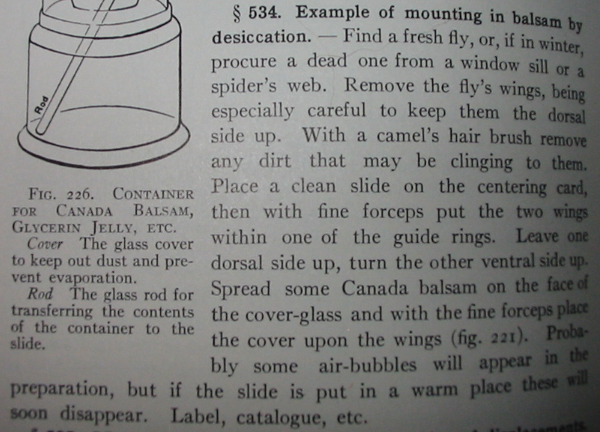
When one buys a big old house it generally comes with a big old attic, and in my part of the world that means scores of dead flies as well. However unsavory it may be to a new housekeeper it is a boon to the microscopist. Yesterday I put together a quick little centering card and today I put it to use. Just as the general plan of that card was taken from the pages of Gage’s The Microscope, so to are our current efforts. A page or so beyond his illustration of the centering card is the innocuous little paragraph shown here:

Image

The entire operation sounds simple enough but let us first assemble the required supplies. One will of course need a number of dead flies, or rather their wings but generally the fly remains with the wings. A similar number of cleaned slips, and their attendant cover-slips should also be readied with labels attached. Labels could be neglected until the slides are finished, but I find it convenient to attach blank labels to my slides before mounting so that I might mark penciled notes upon them if the need arises. The centering card which was made previously should be brought out, or some other means of positioning the specimens in the center of the slip. A fine camel hair brush, a pair of forceps or two, and a pin in a holder will prove invaluable, but could be dispensed with by the specially careful and dexterous. Finally a resinous mountant is required. I will be using natural balsam today but Euparal or one of the synthetics could be used in its place.

I collected nearly a dozen dead flies this morning from the floor of my attic and a quick look at my Audubon field guide showed them to be some species of Pollenia, very likely P. rudis. Identification is somewhat secondary to the goal here, though It is nice to be able to properly label the prepared slides and enter the scientific name into ones catalog. If an identification can be made wonderful, but we are really out for mounting practice today. My specimens gathered I retired to my work area. It is often a great help to work over a surface on which the specimen stands out in sharp contrast, so I laid a sheet of plain white copy-paper on my table and deposited the flies in one corner.

The specimens being exceedingly dry at first rendered dissection quite tedious. Each attempt at grasping the body of a fly with forceps resulted in a powdered portion of Pollenia. I tried holding the fly to the table with a camel hair brush and carefully pulling the wings off by grasping them at their base with my forceps and had some success. In the end I found grasping the abdomen lightly with one pair of forceps and pulling the wings off with a second pair of forceps by grasping them their root the most expeditious method. I took care to keep aware of which side of each wing was dorsal and completed each slide before beginning an other dissection.

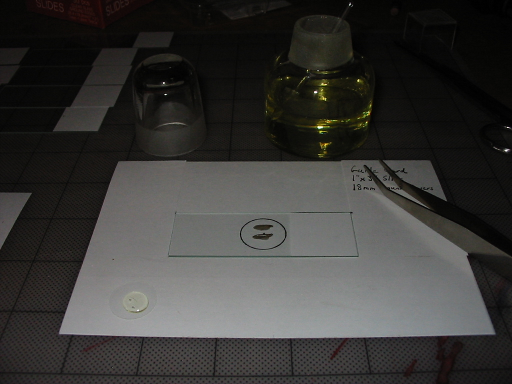
Image

With a set of wings removed I placed a clean slip upon my centering card and transfered the wings to it on the tip of a camel hair brush. Once there it was easier to position the wings using a needle as the wings showed a tendency to adhere naturally to the brush. I positioned the wings around the center of the slide as recommended by Gage with one dorsal side up and the other ventral.

Next I placed a large drop of balsam in the center of a cover-slip and allowed it to spread out a bit of its own accord. I found the amount of balsam excessive on my first attempt and in the remaining slides I was careful to apply less and spread it out on the cover-slip with the glass applicator rod.

Image

Gage recommends placing the cover-slip by grasping it with forceps. Some people find this a simple operation but I often end up grasping it rather too firmly and damaging it. When placing a cover-slip I find it simpler to grasp it by the edges between the thumb and fore-finger, lowering it vertically so that the suspended mountant touches the specimen first. Upon releasing the cover-slip a small amount of even pressure is all that is then needed to complete its application. This method helps to prevent specimens which are not affixed to the slip from moving from their intended position.

In the space of forty minutes or so I was able to produce ten slides and each one showed at least one air bubble. I placed each slide in a covered tray and carried them to the attic. Gage wrote that “if the slide is put in a warm place these will soon disappear” and I expect it will reach eighty degrees Fahrenheit in the attic some time this afternoon. One can only hope that the bubbles are expelled.

A Dull Return; The Centering Card

After a few weeks of seemingly endless labor, waiting, and paperwork, I’m all moved in to my new home and finally privy to some free time for microscopical pursuits. One of my upcoming efforts requires a very simple apparatus that positively anyone can construct at home, and no maker of permanent mounts should be without: the centering card. When producing a slide one must be mindful not only of the handling of the specimen, but of the appearance of the finished slide as well. An excellent specimen and fine label can go a long way towards providing a professional look, yet the effect may be spoilt by something as simple as an off-center cover-slip.

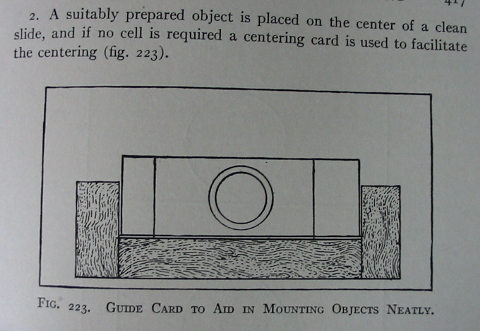
A centering card is a surprisingly simple device which I first saw illustrated in the pages of Simon Henry Gage’s perennial work The Microscope. The illustration below is taken from the sixteenth edition of that august work.Image

One can see just how simple the thing is and and acknowledge the virtues of a well centered cover-slip yet still fail to appreciate the utility of the centering card, until of course one puts such a card into use. Of all the methods and devices one may use in centering a cover-slip none is quite so straight forward and versatile, so let’s set about producing one.

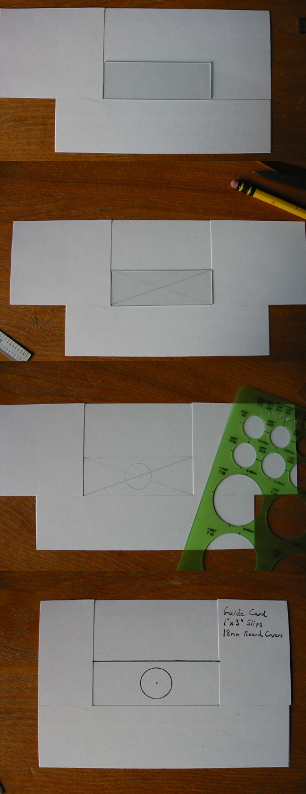
No very specialized materials are required to construct such a card and one can utilize whatever is on hand. Today I used two 5″x7″ index cards, a pair of shears, some rubber cement, a pencil, a pen (not pictured), a ruler, a 1″x3″ slide (not pictured), and a circle templet by Staedtler (not pictured).

Image

One may of course use far more durable materials than an index card, anything from poster-board to wood or even metal might serve admirably, and I would encourage those so inclined to make use of what they have. For my own part I prefer index card as the entire centering card may be produced so rapidly from them that it is a simple thing to produce one for any particular dimension of slide or cover-slip as the need arises.

After collecting the required supplies one must cut one index card into three pieces as I have already done in the above image. The goal is to produce three specific pieces: one with a long and perfectly straight edge, and two with perfect right-angle corners. Once the cuts are made the first two pieces may be glued to the second (whole) index card. By afixing the first long piece across the bottom of the second card, and one of the right-angle pieces tight against it, a depressed area with a perfect right-angle is produced. It is then a simple mater to position a slide against the edges of those two pieces and glue the third piece to the card so that a three-sided depression exactly fitted to the slide is produced. Tracing a pencil line along the top of the slide and drawing two diagonals with a straight edge pinpoints the center of any slide of the same dimensions placed into the card.

One may now finish the card for whatever size cover-slip one intends to use. For my next effort I will be making use of 18mm circular cover-slips so using a circle templet (though a draftsman’s compass would work as well) I marked the area around the center point accordingly. In the case of square cover-slips it’s a simple thing to position them with the aid of a ruler. Finally I noted on the card the dimensions of the slide, and cover-slip for which it is intended.

Image

The entire operation took only five minutes and produced a functional centering card that will save me the stress of trying to “eyeball” the position of my upcoming mounts. There are of course commercial devices that can serve the purpose of our humble card, and one can often achieve quite good result simple by preparing their mounts over quadrille-ruled paper, but the speed with which one may produce a serviceable centering card specific for slides and covers of any dimension, makes them a must in my book.