Freezing Cold and Falling Skies

The natural world is home to a seemingly limitless supply of interest for any microscope owner. Nature might not always supply what your looking for, but there is always something to look at. -K

Faced with a seasonably cold winter and a terrible lack of snowflakes suitable for microscopy, I spent the morning thinking about what I might get out and collect now that wouldn’t be available in a few months when the seasons change. Snow is the obvious perishable commodity, of interest are the things carried by it. In particular areas algae and even pollen will color the snow, much to the wonder of people like the late, mad, Charles Hoy Fort.

A peek out the window showed no colored snows in evidence, only driven white powder made up of tiny balls thanks to the wind and temperatures higher up in the atmosphere. Snow, like rain, has the habit of bringing down things from the heavens; rain drops form around a nucleus of minute particulate matter and carry it to Earth, as does snow. Soot from chimneys, dust, pollen and even pollution are some of the more mundane things that fall with snow (or rain), but there is another passenger that comes from much farther.

Micro-meteors bombard the planet constantly and fall to the ground on their own, or with rain and snow as micrometeorites. In warm weather one can collect water from a downspout and search for bits of extraterrestrial material with a rare earth magnet. Anything sticking to the magnet, of minute size, and bearing a characteristic appearance is a likely micro-meteor. With roofs and gutters the way they are one will only end up with what happened to strike the roof.

Snow affords a unique opportunity to take samples from wherever one would like. This afternoon I went out to the garden with a large plastic storage bag and a 1 liter beaker. I held the bag open and dragged it across an area of new fallen snow about one meter square going down 2 centimeters or so. I didn’t pack the snow down and ended up with a quite full 2.5 gallon zip-lock bag of snow. Choosing a similarly undisturbed area I proceeded to pack snow into the beaker.

Things have been meting for a while now and there appears to have been all manner of things hidden in that clean white snow. When everything has melted I’ll take a close look at just what was hidden away and try a little write up of what was found.

Acid, Safety, and Suppliers.

You can buy just about anything on the web these days; everything from acid to xylene is a mouse click or two from from website to doorbell. It’s harder to know what’s safe than it is to recognize the hazardous so permit me to give a little example. -K

The weather this winter has conspired with my professional obligations to prevent (so far) the collection and mounting of any snowflakes. I’ve kept busy with other things and a fair bit of reading; some of that reading involved methods in diatom mounting. As a result, I found myself extending my chemical supplies in preparation to include some acids I normally wouldn’t keep on hand. I ended up ordering a bottle of concentrated (31%) hydrochloric acid from a supplier I hadn’t dealt with in the past.

Everything was nicely packaged with appropriate hazard labels and an externally attached pocket housing the applicable MSDS. Very professional really and beyond compliance with applicable regulations. When I opened the package I was unpleasantly surprised to find that the bottle of acid had leaked (I’ll blame the thermal effects of sitting on my doorstep in freezing weather and a delivery man who doesn’t understand what a arrow is in this case) and that bag around the bottle held about 20ml of exuded acid and one very dissolved label. Wonderful.

I could have left the bag unopened until such time as I needed the acid, but that’s not good practice. Naturally in dealing with an unfamiliar chemical my first action was to go to my chemical atlas and verify the properties of the chemical with the information on the MSDS. That complete I got together my protective equipment. Gloves and goggles are a must for handling acid and most people would certainly know that, however, the type of gloves might not be so readily known. If I wore latex gloves I would suffer an acid burn in moments and nitrile gloves would only be worse (spontaneous oxidation). Thankfully I have a number of heavy PVC gloves and a rubber apron.

I might have gone a bit overboard but safety is important and never more-so than when dealing with the unfamiliar. I cleared a table in my work area set up a ring stand with a funnel and labeled a clean HDPE bottle. I then stoppered my chemical resistant plastic sink (the entire make up of the sink and it’s stopper is plastic which is important as there are a lot of things one wouldn’t want to put in a metal sink) and got my canister of soda ash from the shelf. Then I suited up with a chemical resistant lab coat, rubber apron, elbow length PVC coated canvas gloves, chemical respirator, goggles and let my wife know what I was doing. Communication is as big a part of safety as anything!

Most every acid can be safely put into a sanitary sewer once it has been neutralized and the MSDS will provide instructions for handling spills. Check with local ordinances before putting any chemicals down the drain and don’t do it if your not sure. Soda ash (sodium carbonate) is a vital safety precaution when working with acid and is among the least expensive methods of neutralizing acid that one can have. If you’re going to have any of the strong acids around, have a few pound of soda ash on hand too.

Well, I put on my exhaust fan (if I had a fume hood I’d have used it, but a fan and a window is better than nothing) and, working over the sink, I opened the bag; low and behold, fumes. It wasn’t unexpected but it’s never fun to see. I would have been fine without respirator or fan just because of the size of the room I was working in but again, safety. With the bag opened I liberally applied a scoop of soda ash and waited for the reaction (not much of one) to stop. One more scoop to absorb the liquid in the bag and the residue on the bottle and that’s that, the hard part is over.

I poured the acid from the bottle into the new container and capped it. Moving the funnel to the sink I put the soda ash mixture from the bag into the old bottle through the funnel to get the remaining residue. I slowly filled the sink with water and verified the neutrality of it with a pH tester before letting it run out. If that doesn’t sound fun then consider a different method of cleaning diatoms!

Divisible Objectives and my Favorite Stand

Things have come and gone in microscopy through the years. Some have been happily put aside as inconvenient when new advances were made and others have been quietly forgotten. I for one lament the passing of divisible objectives. -K

For a great many years it was considered abnormal and a genuine extravagance for a microscopist, even a professional, to be in possession of more than one stand. Optical apparatus was expensive, prohibitively so. Before continuing permit me to digress and provide an bit of example; consider that in the 1930 bound catalog of Bausch & Lomb an achromatic objective of 2x magnification was priced at $5.00, the equivalent of $71.10 dollars today. One could also have a 10x for $8.00 ($113.76). The full complement of dry achromatic objectives with magnification spanning 2x to 60x, some eight objectives in all, would have cost the princely sum of $86.00, $1222.93 in todays dollars according to the consumer price index, and been beyond the means of even the well-funded.

It’s easy to understand that for most microscopists it proved sensible economically to purchase a middle of the range 10x objective and use it with a comparatively inexpensive low power ocular when less magnification was required switching to a more powerful ocular as nessacary. In part because of the expense some things were done that would not be considered sound by the standards of today. One of those things, which no doubt seems somewhat blasphemous to todays workers, is the divisible objective. They turn up not infrequently on stands dating to what I think of as the “Black & Brass” era with rarer examples in the “Fully Brass” period preceding and becoming most common in the “Fully Black” period after the first world war. I can only hope for forgiveness regarding my rude designations of time but this is all very general.

A divisible objective is one in which the front and back optical components may be separated to obtain lower magnification. Bausch & Lomb produced these prolifically in the 16mm size so that with the front component in place 10x magnification was provided, while the rear portion only provided approximately 4x. By purchasing a divisible objective one was effectively provided a 16mm and 32mm objective in one unit. Most of the manufacturers provided divisible objectives of one sort or an other but the divisible 10x was certainly the most common from any source.

In 1925 Bausch & Lomb was granted a patent for a new system of constructing parfocal objectives that no doubt grew out of observations made while manipulating divisible objectives. The patent may however, have been an effort to cut down on competitors production of divisible objectives more than anything else, as the usual method of employing rings of varying thickness around the threads seems a great deal more convenient.

Image

For comparison

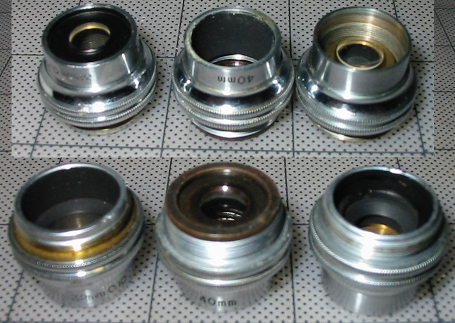
Above one may see a B&L 32mm objective, 40mm objective, and 32mm equivalent portion of a divisible 16mm objective. It’s worth noting the differing position of the optical components of the objectives and that any of these objectives will work usefully on a compound microscope. The stand seen below is a perfect example of the sort of microscope on which one could expect to find a divisible objective.

Image

No clips because I never incline my microscopes, it being my habit to work standing

The above is a Bausch & Lomb stand from the late 1940’s (easily dated by the double knurled heads). One can see the assembled 10x divisible objective in position and compare its outline with that of a non-divisible objective. This is in fact my favorite stand for micrography, photomicrography, measuring, and most general work, it shows every evidence of having been an economically prudent apparatus while not neglecting function.

This particular stand was assembled by Lukas Microscope Service of Skokie, Illinois. The company was founded in 1931 and is still in business today. They provided this microscope with a fixed, removable, 1.20 Numerical Aperture Abbe condenser with iris diaphragm and filter holder, the usual two sided mirror, and three objective turret. I keep a divisible 10x B&L, a 43x B&L, and a high dry 60x B&L in place on this stand and find few objectives more suitable for measuring the thickness of a mounted specimen than the 60x.

One final point concerning this lovely instrument, it is the most modern model I own which retains a draw tube. For any who are products of the modern age and have not had the pleasure I will say a draw tube can be unspeakably useful. Properly dispositioned it’s the work of a moment to compensate for an unexpectedly thick (or thin) cover glass, or increase or decrease magnification. Of course there are attendant sacrifices optically but I can’t count the times I’ve been able to better measure the size of a structure because I’m familiar with the workings of a draw tube for given combinations of objective and ocular.

General Program for Preparation of a Chitinous Specimen with Pressure

In the previous series I stretched a rather simple mounting technique out to a few thousand words. I did my best to make things clear and explain the why and how of things. It’s easy to understand that way, but it’s easier to follow along with brevity. Here’s the same information all in one page and about 500 words. Easy to print out and refer to as required.

1) Remove killed and fixed specimen from storage, clean superficially with a camel hair brush, and bring into distilled water if necessary (removing fixatives such as alcohol or formalin). Dry specimens do not need to be brought into distilled water.
2) Place superficially cleaned specimens into a 10-15% solution of caustic potash (Potassium Hydroxide) or caustic soda (Sodium Hydroxide) for macerating. Ensure sufficient of the macerating solution is present to remain at 10% concentration when the fluid diffused from the specimen(s) are added to it.
3) Retain specimen in solution for 12-72 hours, or until visual signs of internal organ decomposition. Alternatively, heat the specimen in solution for up to 30 minutes to accelerate the process, do not allow the vessel to “boil dry.”
4) Remove specimen from macerating solution and wash in several changes of distilled water.
5) Add 5 or more drops of acetic acid to specimen in distilled water, both to ensure complete removal of macerating solution and to further soften chitinous tissue. If required specimens may be stored in strong acetic acid until ready to continue.
6) Apply pressure to bulbous portions of the specimen with the butt of a camel hair brush or needle holder, working from the head and expressing liquefied internal organs through the anus. For small ants and thin bodied specimens this treatment is not required.
7) Lay specimen out in position desired for mounting on slip not suited for general mounting (slips with chips or imperfections may be used). Arrange all appendages as desired before continuing.
8) Place a second slip over the first applying pressure first at the head of the specimen, hold slips together closely and prevent slipping of one across the other.
9) Use clips or other convenient apparatus to bind slips tightly together.
10) Place bound slips into vessel of anhydrous alcohol (95% denatured if none better is available) and leave for not less than 1 hour to dehydrate and harden. Specimens may be left in alcohol until convenient to proceed.
11) Take bound slips from alcohol and hold close while removing clips holding them. Separate slips flooding with alcohol so that the specimen does not adhere.
12) Wash specimen into watch glass with alcohol and use a camel hair brush to remove any internal debris that adhere to the specimen.
13) Transfer specimen to clearer required by the final mounting medium to be used. Leave for as long as the particular clearer demands. 1-24 hours is the usual time.
14) Take specimen from clearer and allow excess to run off before placing onto clean slip for mounting.
15) Apply mountant to one side of a cleaned cover glass of appropriate size for the specimen and lower directly onto specimen.
16) Add mountant at edge of cover glass if insufficient mountant was used, clean exuded mountant from slide in the event of excess.
17) Affix temporary label to slide and put up for mountant to cure as required.

Just a Little Reminder

I almost forgot! It is of course a new year and time to renew ones membership in any of the microscopical societies one fancies. I strongly recommend membership in the Royal Microscopical Society. The RMS has a long, and storied history as well as a vibrant and inspirational present. It is an excellent resource for both professionals and amateur enthusiasts. The RMS is welcoming and an incredible resource, whatever ones background and occupation.

Before thinking that a professional society oriented around the microscope and all of its applications and technologies would be a waste of money for a casual enthusiast, one would do well to consider the benefits. There are a number, and they’re all outlined on the RMS website in a better format than I can give here. But I will make my little pitch nonetheless. While looking around their site why not check out some of the past articles in old editions of infocus, the societies popular magazine? I’d say that it alone justifies the price of membership and I look forward to every issue. In the most recent issue there’s a timely article on the basics of capturing photomicrographs of snowflakes, and a really exciting and inspirational look at the latest work of Professor Milton Wainwright who has identified biological entities in samples taken 27 kilometers up in the stratosphere, not the sort of place one expects to find a fragment of diatom!

One other exceptional benefit of membership that I really have to mention is the discount provided to members for purchases at wiley. I recently made use of the discount to pick up the new edition of Current Protocols Select: Imagaing and Microscopy at an excellent price. The 2013 edition has been expanded and updated to the point that I was no longer content to run to the library when I needed to consult it and the RMS discount enabled me to get a copy of my own for a price that didn’t have my long suffering wife locking up my wallet.

Alright, enough of being a shill, but if you’re at all interested in really putting your microscope to use or even just seeing what others are able to do with theirs, consider membership in the RMS or one of the other outstanding microscopical societies.

Clearing and Mounting

The next bit is rather simple compared to everything previous but does require a bit more dexterity. It is important to remember that not all the specimens that have reached this step will come out unscathed. In fact, some specimens might not be suitable because they have been damaged in those earlier steps! Ever heard some tough walking cliché say “pain is weakness leaving the body”? Well friends, failure is just experience entering the body. Believe me, if I can do this, so can you.

At this point one should have a container of alcohol (denatured is fine provided it’s 95% or better) with specimens inside held together between two slips. During their time in the alcohol the water in the specimens has been dehydrated out by the alcohol. After having been used a number of times (more or less depending on the initial quantity of the alcohol and size and number of the specimens) the small amount of water present in the specimens will be enough to dilute the alcohol noticeably and it should be retained for other uses that require less complete dehydration.

One might be aware that besides dehydration alcohol will act as a hardener on many organic substances, chitin among them. Ardent hikers should know the old trick of preventing blisters by hardening the souls of ones feet with rubbing alcohol before a big hike. The hardening effect of alcohol will ensure that our specimens remain in shape for mounting, but it will also make them quite brittle. Avoid the temptation to rush and be careful as possible in the upcoming steps.

With a large watch glass or Syracuse glass on the table, and a wash bottle or pipette of alcohol at hand, remove one set of slips from the container of alcohol. Slowly remove the clips holding the slips together and separate them a small amount by sliding one or the other slip away. Resist the urge to lift the slips apart as an antenna or leg might more easily break off with that motion. Once the slips are slid apart a small amount it should become apparent that the specimen is more affixed to one slip than the other. Work with the slip to which the specimen is most attached at the bottom so that the specimen is facing upwards and keep the specimen wet with alcohol while gradually sliding the other slip away.

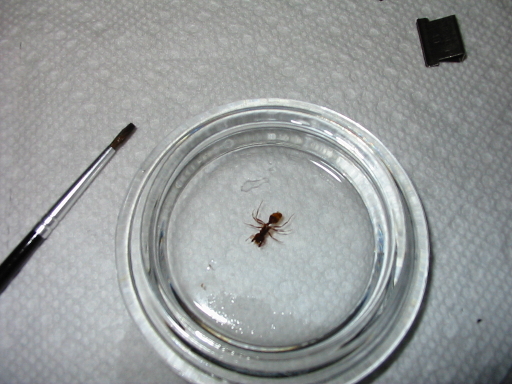
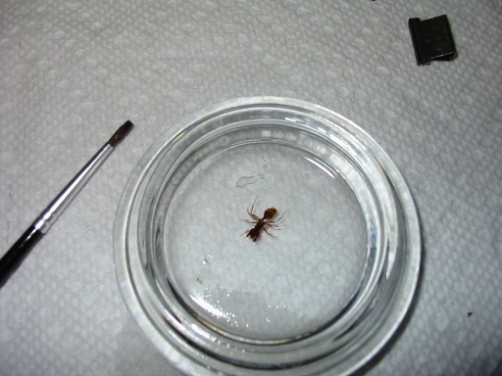
Once the top slip has been removed use a stream of alcohol from a wash bottle or pipette to rinse the specimen into the watch glass. With the specimen in the watch glass give it a quick look with a hand lens or dissecting microscope to see if any debris is clinging to it. Use a camel hair brush, fine needle, or eyelash to remove any debris from the specimen. If only a few specimens are being processed they may all be washed into the same watch glass before proceeding, or one may wish to finish each specimen before beginning the next. The choice largely depends on how much space is available in which to work, but I prefer to move each specimen though the process one at a time.
Image

An ant washed into a Syracuse glass for cleaning

If the specimen has been macerated too long, not long enough, or has been otherwise damaged it should be obvious at this point. Whether or not to continue with a damaged or poorly treated specimen is up to the microscopist. An ant that has broken off legs or antennae, or one that is falling apart from too long a maceration can still make a serviceable mount. If the abdomen has been disintegrated (as sometimes happens when macerated too long) consider mounting only the head, mouth parts, antennae, or legs. If the specimen is clearly too thick or still retains its internal organs one can wash it in water and return it to the macerating solution, or start anew with a fresh specimen. Whatever the case, keep written notes on the quality of the specimen had at this point, as it relates to the operations performed on it. It’s one thing to read someones account saying a day or two of macerating is sufficient and something else entirely to know from experience that 48 hours of macerating is too much for one specimen and not enough for an other.

Once satisfied that the specimen is free of debris it must be cleared. Clearing is a simple operation in which the fluid of the specimen is replaced with one which is miscible in the mounting medium to be used. If working with Euparal for instance the clearer used would be Euparal essence or even simple the purest most anhydrous alcohol available. With Canada Balsam (sometimes called xylol Balsam, neutral Balsam, fir Balsam or simply Balsam) one has their choice of clearers, the one selected being largely a matter or preference the procedure is the same whichever is used. Three of the most popular and readily available clearing agents for Balsam are turpentine, xylene, and Clove oil. Of the three Clove oil is the safest to work with (though it is also more expensive and harder to find than either turpentine or xylene) and it is worth noting it has the least offensive scent.

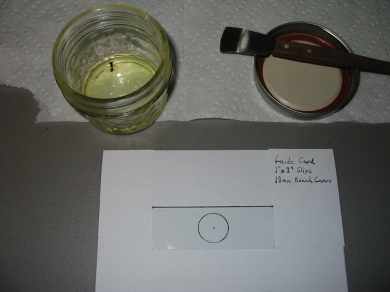
With a fair amount of clearer in a small jar close at hand, remove the specimen from the watch glass using a section lifter, dry camel hair brush, fine forceps or whatever is convenient. Once lifted from the watch glass allow as much alcohol as possible to flow from the specimen without its drying out completely. A small corner of filter paper can be touched to large specimens if necessary. Place the specimen into the jar of clearer. The amount of time required for the clearing agent to penetrate the specimen is dependent on its size and just how well macerated it is. I find that 24 hours is nearly always enough time but have used as little as one or two hours in the past.
Image

Ant in clearer with section lifter and centering card

After 24 hours the clearer should have penetrated the specimen entirely and replaced the alcohol that was used to dehydrate the specimen. If xylene was used as the clearer and it was observed to become milky when the specimen was placed into it then specimen was not fully dehydrated and should be placed into pure alcohol for an hour or so then put into a new dish of clearer. With a fresh and scrupulously clean slide laid out on a centering card the specimen should be removed from the clearer and laid out as desired. It will not be quite so brittle as it was after being taken from alcohol but one must still be exceedingly careful with the delicate appendages.

With the specimen centered on the slide take a small corner of filter paper and leach away any excess clearer clinging to the slide without removing that which wets the specimen. At this stage I find that Clove oil is not only the best smelling clearer but the most forgiving. It will not evaporate nearly as fast as turpentine or xylene and provides some valuable extra time with which to ensure that the specimen is positioned properly. Unfortunately, this also means that specimens produced with Clove oil as the clearer will also require a longer curing period.

Cover slip placement is often treated as a matter of preference but I vigorously oppose that notion. For particular styles of mounting, particular methods of cover slip placement are undoubtedly superior. The best method is however that with which the mounter is able to achieve the best results. In the case of pressed and macerated insect mounts it is easiest to place a drop of mountant on the cover slip and then lower it directly onto the specimen. This method does the most to prevent displacement of the specimen and is the method by which the amount of mountant used is best gauged, an invaluable asses to the novice. One large drop or two small drops from a slender glass rod is about right for most specimens the size of a harvester ant.

Once the cover slip is set one may chose to apply a small amount of pressure with the eraser end of a pencil or a camel hair brush but its not often necessary. Any excess mountant exuded may me cleaned up with bit of filter paper, but take care not to disturb the cover slip. The slide may now be placed in a cool oven or incubator (if one is available) for a few hours to cure. The time required for curing depends on the mountant and clearer used as well as the temperature. If time is of the essence the slide may be warmed over a spirit lamp or Bunsen burner to hasten things along, but superior results are often achieved by simply placing the slide in a case of some sort to keep the dust off and putting it on a shelf or a hot summer time attic for a few weeks. At room temperature a natural Balsam mount with Clove oil clearer can take as long as two months to cure.

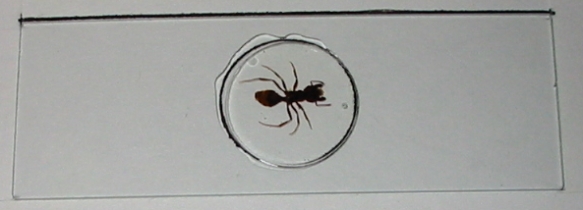
Don’t be discouraged by the waiting time, the longer the period which is available for curing the more opportunity there is for any bubbles in the mountant to work their way out. In some up coming posts I’ll write about putting together a simple slide dryer and ringing a mount of this sort, but for now here’s an ant thats been produced over the course of these blog entries:
Image

Note the air bubble to the right of the lower antenna, and how unconcerned I am about it
New Year, Next Step

Happy new year! How appropriate that today begins a new step in the preparation of a whole insect mounted with pressure. The previous step was maceration and some specimens will always macerate faster or slower than others. Seeing as I must return to work tomorrow I decided to move things along today, even though one specimen appeared unready.

Image

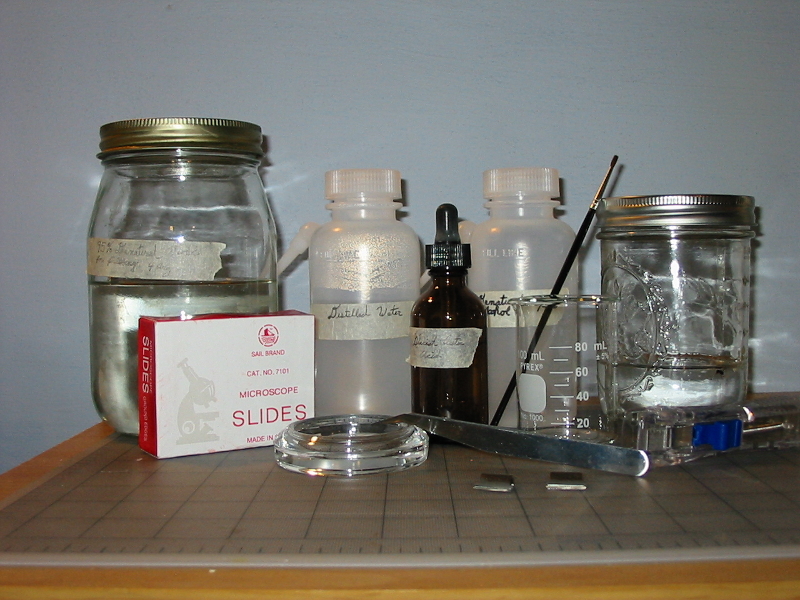
Todays supplies

After the (Chemical) Fire

No there hasn’t been an accident, but after just over fifty hours of macerating the ants may appear as though there has been. When they were initially placed in the macerating solution each ant was quite buoyant, floating on the surface of the liquid. Withing twenty-four hours small bubbles were in evidence on the surface of their abdomens and they were noticeably less so. In the early evening of yesterday one of the ants was observed to be exhibiting neutral buoyancy. This morning it was resting on the bottom of the macerating jar with its abdomen appearing markedly lighter in color than the other. Enough time was felt to have passed for the next stage of slide preparation to begin on the sunken ant at least. Operations were carried out on each in any case.

Until today every activity performed on the specimens has consisted of nothing more than placing them in some container of liquid and waiting. At first today will prove no different. The ants will be transfered to an empty container and washed of the macerating solution. After this, any remaining traces of the macerating solution will be neutralized chemically. Finally the specimens will be pressed, dehydrated, and hardened.

A Wash and a Brush Up

Remove the macerated specimens to a small container. I find that a low profile beaker is best but any small container with a spout will prove convenient. Once the specimens are in the empty container pour over them a quantity of distilled water and leave them for not less than fifteen minutes. After fifteen minutes pour off and replenish the water. This activity may be carried out more or less extensively depending on the preparers confidence in ridding the specimens absolutely of the macerating solution.

Some mounters (among them R. M. Allen in his manual The Microscope) recommend performing the process of washing over the course of several hours. It is also possible to hasten the procedure by washing in the more cursory way described above provided an acid is used to ensure the absence of any Sodium Hydroxide after washing. I have read in one account or an other that after removal from the macerating solution the specimens may be washed and placed into a vessel of concentrated acetic acid and left indefinitely. I have never done so personally, I may post about the effect if I ever do.

After the second wash the ants were removed to a Syracuse glass of distilled water. Once there they were lightly spread with a camels hair brush to remove them from the posture they had taken after killing, five drops of glacial acetic acid was introduced to the Syracuse glass. For particularly bulbous insects the abdomen may be pressed gently with a camels hair brush while in the Syracuse glass. This will discharge the liquefied organs and help to make the following step easier. For the small ants I used this was not warranted.

Layout and Pressure

Put out two clean glass slips for each specimen, these will be used to apply the pressure needed to flatten the subject for mounting later. With four slips on the table, one need not use expensive slips of first rate quality provided only that they are clean, remove one ant to the center of one slide and using a corner of blotter paper draw off as much liquid from around the specimen as is possible without drying it entirely. Removing the liquid is not essential, but will help to ease the process of arranging the specimen.

With a clean camels hair brush and fine pair of forceps (or fine, blunted, dissecting needle) arrange the ant as desired on the slip. Care should be taken to extend the antennae, mouth parts, legs, or any portion which is of interest. One should act quickly so that the specimen is never permitted to dry out completely. Once satisfied with the arrangement lower a second slip onto the first so that the head contacts the lowered slip first and the edges of each line up. Carefully apply pressure while maintaining the alignment, failure to do so (lateral movement of either slip) may tear specimen.

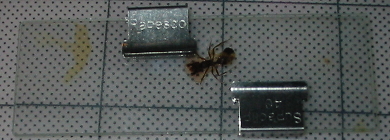
Once the slips are as close to each other as careful pressure with the hand permits the slips must be bound together. An assistant could tie a short length of strong thread around either end of the slips, or any number of a variety of spring clips may be applied. Clothes pins may be used but they are quite bulky. The traditional binder clip is superior but one must search out a supply that is composed entirely of plain metal.

Image

A specimen pressed between slips for placement in alcohol

Hard and Dry

As soon as the slips are bound together they are placed into a vessel of alcohol sufficiently large and full that the entire slip is submerged. The alcohol should be not less than 90% pure, but denatured alcohol is perfectly acceptable. Two things will be accomplished by the alcohol in this step; the specimen will be dehydrated, and its tissues will be hardened in its flattened condition.

Once in the alcohol the specimens must be left for a period of time that is largely dependent on their size. Allen describes the required time only as “short” and I will not hazard a guess as to the unit of time that best describes. I can say that the slips may be left in the alcohol until it is convenient to carry on. I have left harvester ants pressed as described above in alcohol for as short as three hours and as long as twenty-five without noticing any difference.

Next time, things finally become clear!