Modern Acessories for Vintage Stands

Partial as I am to Bausch & Lomb I’m not one to neglect opportunity when it comes along. -K

One great trouble of the amateur microscopist is that economics often dictate the equipment one works with. This is apt to be a vintage or downright antique microscope and the accessories associated with such a microscope are available only rarely. That rarity does not translate to economy. Naturally, occasions come about when some piece of apparatus might be found inexpensively and in working condition; otherwise one is left with little choice than to make their own accessories, which can be enjoyable but is not always practical.

Recently I came upon an individual who produces a limited range of modern accessories for a number of redly available microscopes from a variety of manufacturers. One of the items is a polarizer and analyzer designed for use with the American Optical 60. Being possessed of one and a bit of disposable income, I purchased the device and it arrived today.

The analyzer appears to be composed of a portion of polarizing film in an aluminum frame. Not in and of itself particularly special but it is very convenient having a nicely mounted bit of film in a frame of just the right size. It is recommended that the analyzer be placed in the body of the microscope below the angled eyepiece tube. Placing the analyzer thusly dispenses with the difficulty of using an eyepiece mounted analyzer, and the tendency of such to be accidentally rotated.

The polarizer is composed of a similar filter, of the sort available for digital cameras, mounted in a specialty holder that fits over the sub-stage lamp. It’s particularly nice that the filter is of a type so easily replaced, for although the analyzer may be left safely within the body of the microscope, the polarizer is apt to become damaged at some point. So long as the housing is in good shape a new polarizing filter may be placed on it at any time. The housing on which the filter is mounted is perfectly constructed to elevate the filter over the profoundly convex lens of the illuminator.

Testing the apparatus shows that it is of suitable quality, better (as well made modern polarizing films are) than the traditional Nicol prisms. Overall it is very nice, worth the expense certainly and gratifying in use, particularly as it has the very tailored feel of being made by one who possesses the exact model for which it has been constructed. I’ve resisted the urge to post pictures and include links, but suffice it to say the set may be found on eBay.

Practical Alignment: Illumination

The terrible thing about an occupation is it’s tendency to occupy; leaving so little time for avocation. -K

One may notice that there are all manner of microscopes on offer, in seemingly endless arrangements. Over time the form of the microscope stand has changed dramatically. For evidence of this one need only browse through the various introductory texts that have been used over the years. Such texts nearly always include a diagram of the microscope and the path of light through the optical components of the same. As much as the diagrams have changed, it never more dramatic than when electric illumination became commonly built into the base of the stand.

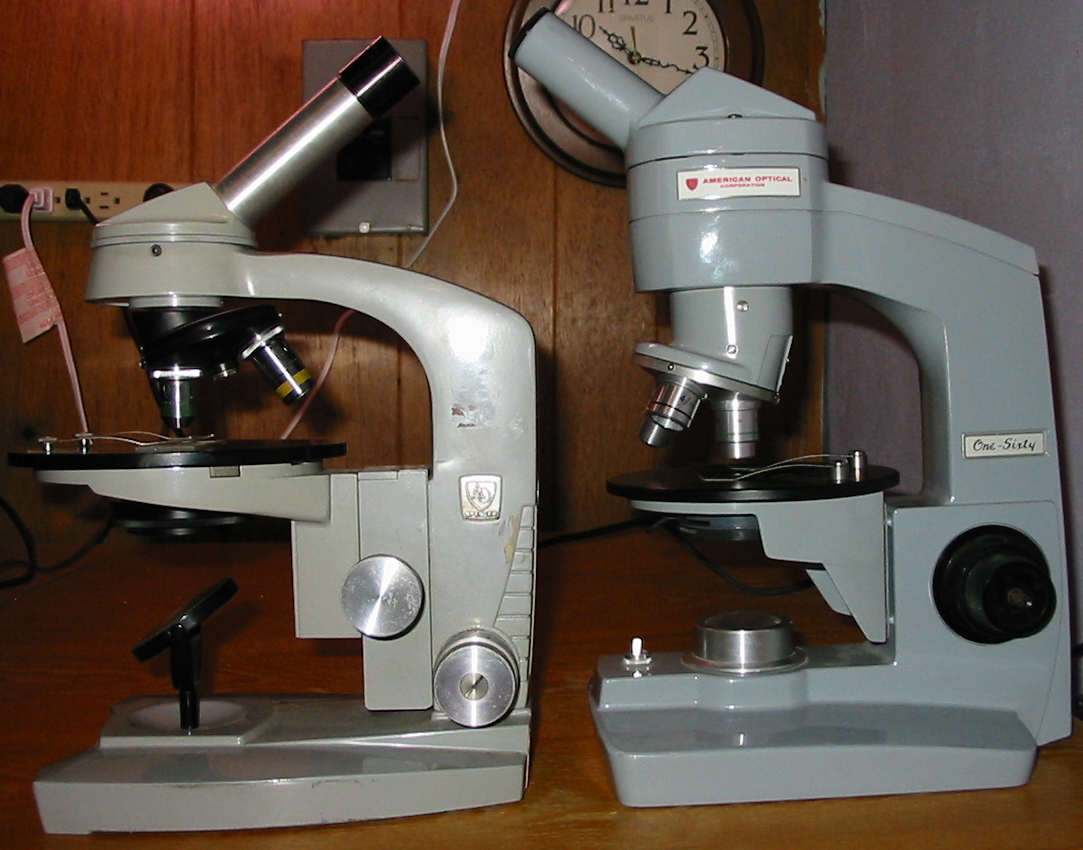
For the task today one may divide all microscopes into two very broad groups, those with permanent pre-aligned illumination and those without. In nearly all cases this will mean referring to a stand having an integral lamp such as the AO One-Sixty seen on the right below, or one with a mirror for reflecting the light from an external source into the optical axis as on the AO (Series 2?) seen on the left. In the AO One-Sixty, alignment is taken care of by the manufacturer. One will never need to perform any alignment at all unless of course one suspects something has gone amiss, but more about that another time.

External on the left, internal on the right.

External on the left, internal on the right.

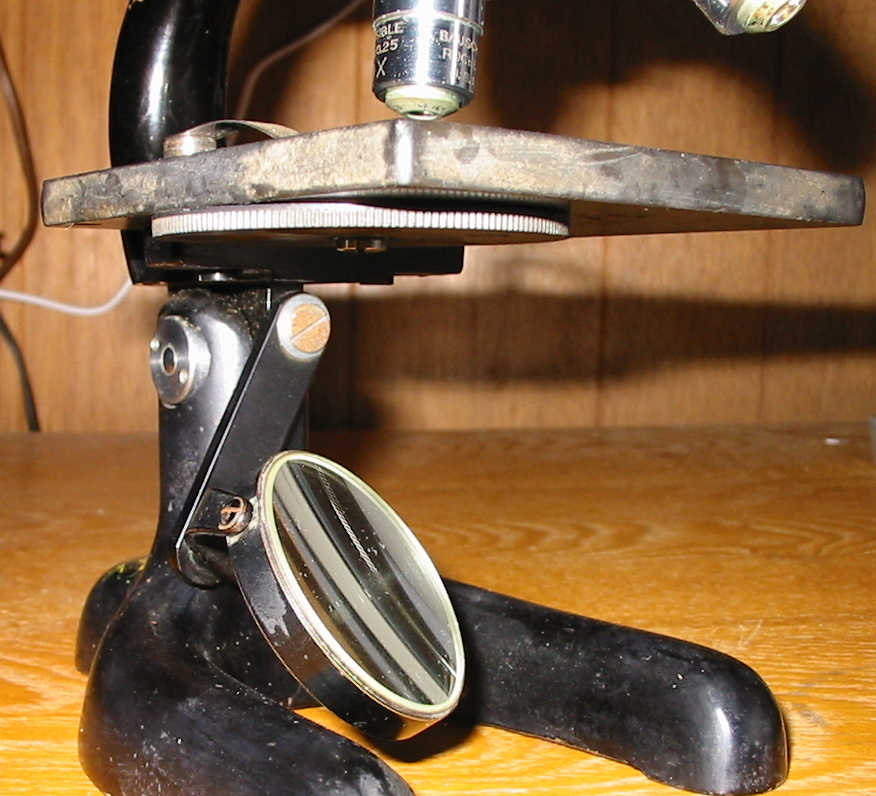
For now we are concerned only with stands having external illumination; those with a mirror. With few notable exceptions the microscope will undoubtedly have a round mirror with two reflective surfaces, one concave and one flat. On the AO (series 2?) the mirror is mounted directly below the fixed condenser. On more traditional stands the mirror is apt to be mounted on a horizontal post that extends under the stage. This post may be mounted horizontally from the vertical portion of the foot which extends beneath the stage, or on an intermediate vertical post which allows for lateral movement; as seen below on this 1940 Bausch & Lomb students microscope.

Swing arm mirror mount

Swing arm mirror mount

There are specialized apparatus and methods of illumination intended for achieving proper alignment of the microscope. Such methods may be time consuming and impractical, particularly when one is unable to leave the microscope set up indefinitely for use when needed. Practical alignment may be thought of as rapid or “quick and dirty” alignment and although imperfect (hardly suited for exacting and critical work) ensures visual accuracy and greatly reduces optical strain.

No special apparatus is required apart from a prepared slide of a stained smear or cross section of uniform thickness. The process takes advantage of the changes observed while working through a range of focus, so it is important to use a slide with an object of uniform thickness. One may employ an ocular of any power and all but the lowest (48-24mm) powered objectives. It is recommended to begin with a 10x ocular and 16mm objective.

Prepare for the process by first setting up the external light source and positioning the mirror to direct a beam of light through the objective and into the eyepiece. If one does not have a condenser and has the option to use a flat or convex mirror, select the flat mirror for use with any objective of more than 4mm (43X and below in general practice).

The Process (with a condenser or concave mirror)

  1. Position the prepared slide upon the stage and bring the objective into focus with the coarse adjustment knob.
  2. Looking through the ocular work the fine adjustment through focus so that one can observe both the lowest range of focus and the highest.
  3. Notice that one small area comes into focus first as one focuses down, and leaves focus first when focusing back up. That area is the location where the light from the condenser is converging.
  4. Adjust the position of the mirror so that the location where light from the condenser is converging is in the center of the field of view. When the area is in the center the illumination is aligned or axial.

The Process (without condenser or concave mirror)

  1. Position the prepared slide upon the stage and bring the objective into focus with the coarse adjustment knob.
  2. Looking through the ocular work the fine adjustment through focus so that one can observe both the lowest range of focus and the highest.
  3. Notice that focus tends to progress from one area of the field of view to the next in a wave. Without an optical surface converging the light (as a concave mirror or condenser would) alignment is reliant on parallel rays of light.
  4. Adjust the position of the mirror so that the center of the wave of focus appears as a ripple extending from the center of the field of view (caused by spherical aberration in the objective) rather than a wave from one side to the other.

The process may seem tedious at first but skill is rapidly acquired. If the concept seems unclear sketching out the rays of light on a sheet of paper quickly explains the variation caused by improper alignment and is quite straight forward.

The E. Leitz Mikas (Micro-Ibso) Attachment

Happened to see a lovely blog post about a fine old 35mm camera and it got me itching to shoot a roll. However, first let’s have a look at a nice common apparatus that will get anyone started in photomicrography! -K

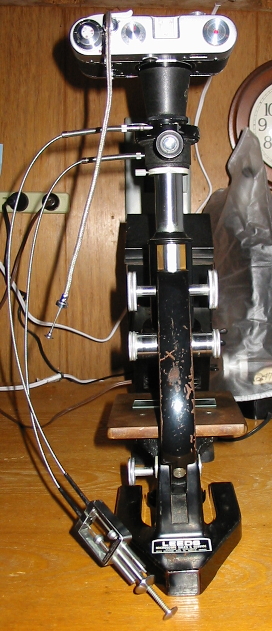
The apparatus fitted to a worn but serviceable stand.

The apparatus fitted to a worn but serviceable stand.

Years ago all the larger firms had a line of photomicrographic apparatus or two. One of the earliest to capitalize on the 35mm market was Leitz who took their popular Leica and adapted a shutter and prism set up to suit the needs of the microscopist. The result was the Micro-Ibso (later to be called the Mikas) a small eyepiece mounted shutter.

The E. Leitz Micro-Ibso (Mikas) photomicrographic apparatus pictured with its case.

The E. Leitz Micro-Ibso (Mikas) photomicrographic apparatus pictured with its case.

The Micro-Ibso features a timed shutter just as one will find on mechanical 35mm cameras, which would have been imidiately understood by contemporary users-even if it might take a bit of getting used to for those who grew up with digital or point-and-shoot film cameras. It’s not overly complex and that’s part of the appeal. The other draw is the versatility, and the viewing eyepiece. Unlike earlier large format microscope cameras, the Micro-Ibso carried a focusing eyepiece and did not require a ground glass focusing plate.

A variety of bellows could be fitted between the shutter and the photo-sensitive material. There are at least three that I am aware of: a 1/3x bellows that was intended for use with 35mm camera bodies, 1/2x bellows called the Macca which took a large format film or small photographic plate, and a 1x bellows called the Makam which was able to take an image measuring 9x12cm on plates or film backs. All of the bellows would screw into the Micro-Ibso and were fitted with reducing lenses-except for the Makam which I understand required no lens.

The 1/3 bellows is perhaps the most common today, and it is likely the one which will be most used. Featuring a standard Leica Thread Mount, the Mikas could be fitted to the camera one already had. In the first picture it may be seen fitted to an old, Russian, FED3 rangefinder.

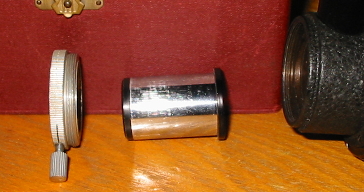
Working up from the base in the photo below, the Micro-Ibso has a threaded ring which fits over the eye-tube of the microscope and is held in place by a convenient set screw. With this ring removed one can seat an ocular (the periplanatic flat-surfaced ocular of Leitz are ideal) into the base of the Micro-Ibso and then screw it in to hold the ocular firmly in place. The ocular itself creates the light-tight connection of the photomicrographic apparatus to the microscope and because of the arrangement adds less than two millimeters to the tube length of the microscope.

Order of assembly with Leitz 10x periplan ocular.

Order of assembly with Leitz 10x periplan ocular.

In the photos one will notice that their are two shutter release cables connected to the apparatus. Only one of these actually controls the shutter, the other operates a spring-loaded prism. When the dual cable release is pressed a prism is pushed out of the optical path before the shutter is tripped so that all the light from the ocular is directed towards the photosensitive material. Naturally one cable is noted as “Prisma” on the dual release adapter and the other is labeled “Verschluss” respectively. When assembling the Micro-Ibso make sure that the “Prisma” cable is fitted to the body of the device and the “Verschluss” to the silver shutter connection.

In practice the Leitz Mikas is a breeze to use. With the cameras shutter set to “B” one simply winds the camera, focuses the object appropriately as seen through the viewing port and selects the best shutter speed for the lighting conditions and objective in use. Depress the cameras release first and hold it while then pressing the dual release to take a photomicrograph.

If the process seems complex then one might do well to note that even inexpensive 35mm film has a resolution equivalent to  15 MegaPixels. Without too much trouble-let’s not even mention the price of a 15MP digital microscope camera-one can find a Leitz Mikas for under $50.00 on online auction sites. Additionally because the Mikas features the common Leica Thread Mount a ring adapter can be found for most modern digital cameras (with removable lenses) so that one can use their modern camera with ease.

Obtaining Unfamiliar Supplies

It never ceases to amaze, the capacity of people to complicate simple things. -K

When the microscope enthusiast is starting out they generally begin with the sorts of objects which may be collected and prepared with what’s on hand. Eventually they may find that there is a clear and drastic line that must be at some point crossed, the supply familiarity line. Some of the consumables used in microscopy are more available these days than previous, distilled water for example, others far less, camphor and red lead come to mind. While the present day MSDS and GHS standards provide an accessible method of understanding the nature of the chemicals involved, and the internet a means of finding them, there is still a greater barrier provided by the marketplace: language. Simply put: people love a synonym, but a duvet is not just any blanket.

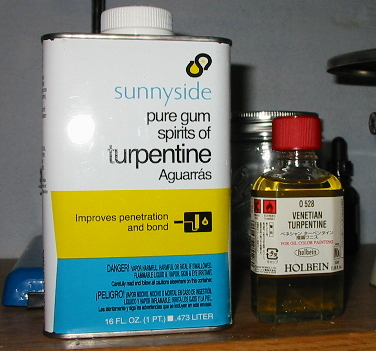
Today I needed to replenish a few of my supplies, and one of them being turpentine, I was reminded of something from my art-school days, “the art store argument”. This argument goes as follows: “A pint of turpentine costs $20.00 at the art store, and $5.00 at the hardware store. Where should one shop?” The initial reaction is likely to be “The hardware store! I can buy a bunch of other stuff with the money I’ll save.” To this the teacher or old-hat will smirk and say something to the effect that “Absolutely not, the turpentine from the art store is of a higher quality and standard, it’s just what you’ll need and will give you results that are well worth the cost. Besides, everyone knows the hardware turpentine smells like embalming fluid.”

At this point I’ll take a minute to say that turpentine was once only one of two products obtained by processing the sap from a variety of species of the genus Pinus. When this sap is refined the distillate is a volatile solvent of primarily, terpenes, that is called turpentine. The residue of this distillation is a solid pitch resin called rosin-the stuff violinists use on their bows. Presently, terpenes can also be extracted from other compounds that contain them in much lower concentrations than are found in pine sap. That method will produce a functionally similar product primarily composed of terpenes, but will contain a significant amount of other VOC’s. In the United States, the name “Gum Spirits of Turpentine” is actually restricted for use with products which are produced from Pinus spp. by distillation, specifically so it may be set apart from other terpene based solvents. The two and a half fluid ounce bottle of turpentine one can buy for $4.99 at the art store, is functionally identical to the $5.00 pint from the paint aisle at the hardware store, it’s produced from the same source, by the same method. Anyone who has experienced the headache and sworn off using cheap turpentine has been using a terpene product that is not “Gum Spirits of Turpentine.”

One of these cost about four times more than the other, and is worth every penny!

One of these cost about four times more than the other, and is worth every penny!

This brings me to my point and the bane of many facing the supply-gap for the first time, language. If reading along in a book, Dr. Carpenter describes a method for mounting a specimen one would like to try that makes use of “Venetian Turpentine,” the reader should absolutely not rush out and buy a gallon of turpentine. A few minutes consulting a dictionary will reveal that Venetian Turpentine is in fact quite different from anything we have discussed thus far. Venetian Turpentine is a terpene distillate produced from the sap of the Western Larch. It’s suitable as a resinous mountant.

When looking for supplies It’s important to know what one needs before one searches it out for purchase. It doesn’t matter if one purchases Xylene as a safer alternative to Benzene or Histo-Clear as a safer alternative to Xylene, what matters is having an understanding of what the substance is required for. The best way to find out what the substance is required for is to understand the process for which it is being used. Once the process and the part played by the substance is understood look to a dictionary, not the internet, not a blog or a forum, a dictionary. Common use is far more flexible than even contemporary dictionaries and is far less reliable. A quick look at a dictionary (which would make the distinction between turpentine and Gum Spirits of Turpentine) cold have saved this old student a bundle. Once one is familiar with the requirements of the substance, and knows what the substance is specifically called, it’s much easier to seek it out with confidence.

The Microscopists Obeisance

The foulest sin in microscopy is to rack down with the coarse focus while ones eye waits at the ocular. -K

Always treat ones instrument with respect and consider the object upon the stage as well. Fine slides and delicate microscopes have come down through the years in such condition and numbers that even a casual enthusiast may have a first rate instrument and broad collection of slides at quite a reasonable price. It’s a terrible thing for such wonderful resources to become lost due to lack of observation of the microscopists obeisance.

When first placing a slide upon the stage orient a likely area beneath the objective and bow. There, with ones head low in deference to the care shown by others whose similar consideration permitted these items to persist long enough to become ones own, look askance towards the stage and rack the focus to set the objective within its focal distance. Then raise ones head and gaze into the eyepiece, hand upon the fine focus; never to touch the coarse unless one again bows low, for science and the preservation of history for generations to come.

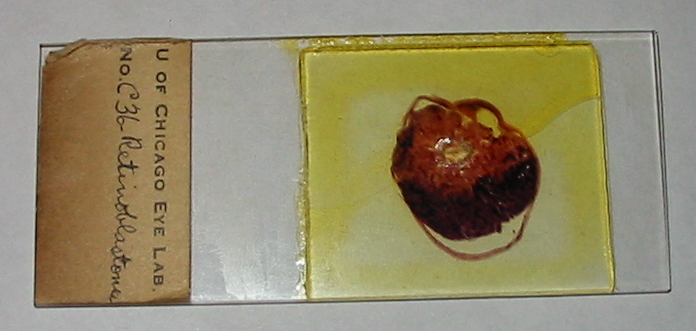
Too many a wondrous specimen and unique objective have perished at the hand of the eager searcher, irreverent hand always upon the coarse focus and eye forever glued to the ocular. Why, just take a look at this poor eye:

Image

The things this slide has suffered, dear me.

A section, showing a retinoblastoma, spoiled by one to proud to take care. Balsam brittle and yellow it will still endure for ages but its perfection is spoiled by a crack (and missing portion) spanning the full length of the 30mm x 35mm cover. At least I can believe that the fool who damaged it learned his error-even at the cost of this slide-for the rest of the series I posses is thankfully free from evidence of such abuse.

So bow, low, and often! Save yourself and the slides in your care from damage such as this, take pride and make the microscopists obeisance!


Ringing a Slide: Practice

I accept full responsibility for the following as the majority is not attributable to any particular authority but only my own experiences. -K

In practice ringing a slide (this deals only with circular covers, when treating with rectilinear covers I will refer to it as sealing) is a simple task and once performed is easily repeated indefinitely, provided a few points are always observed. The keys to successful ringing are entirely mechanical and essentially every other aspect can be overlooked provided the mechanics are given priority. For example the sealing cement is less important than it’s viscosity and the position of the ring much more crucial than its appearance.

The easiest cement is often the one on hand, but for beginners or those wishing only to get a feel for the practice I can not more highly recommend gold sizing. For those unfamiliar, gold sizing is a gilders sizing cement for the application of (primarily) gold leaf. Any of the larger art supply houses can provide a suitable gold sizing and it may generally be found among the model paints. Available in a number of grades, look for one which is described on the label as “fast drying” or “suitable for exterior varnish.” It will likely be the least expensive of the sorts on offer. Do not purchase gold size which is described as “for picture varnish.” Higher grades of gold sizing dry incredibly slow, some behaving more like an oil paint in that they never set up completely which is wonderful protecting art which needs to breath, but not for sealing a coverslip.

Acquire also a fine camels hair brush, any will do provided it may be pointed (either purchase a pointed brush or plan on trimming it) and has natural bristles. Gold sizing may be cleaned from the brush with xylene (xylol in Germany and many continental European countries) and many synthetic bristles will dissolve partially (or completely) in xylene and similar solvents (benzene &ct.).

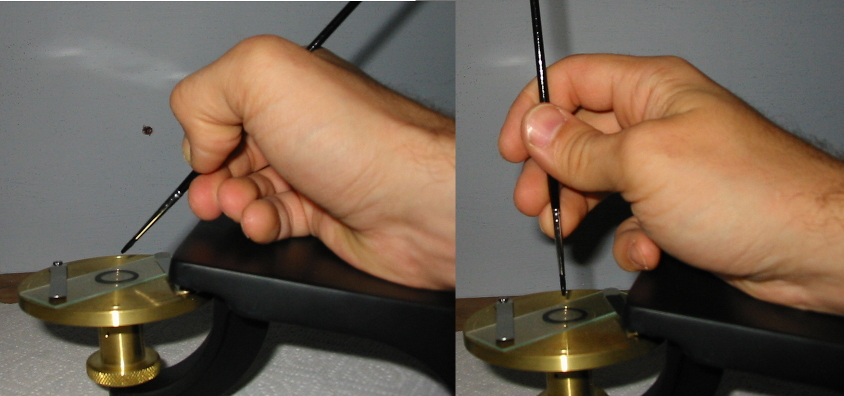
One should already have a ringing table of some sort. If not, Brunnel in the UK and BioQuip in the US appear to be the only contemporary sources. If one would purchase a second hand turntable or construct one for themselves it must be outfitted so that it turns perfectly without wobble, and freely completes many revolutions at a fair speed without slowing. There should be a simple means of holding the slide quite firmly and some convenient and sturdy rest for the wrist and forearm. I prefer a rest which supports the hand above the surface of the turntable so that the wrist may be held straight while holding the brush vertically over the slide.

Prior to beginning one should clean the slide thoroughly; first scraping any exuded mountant with the dull side of a heated scalpel and following by a lens paper wet with a small amount of an appropriate solvent. When positioning the slide to be sealed upon the turntable one must be sure to center not the specimen, but the coverslip. With turntables that are marked by concentric rings (as most are) it is simple to get the position if the coverslip is near to the size of a marking. In any case once believed to be centered set the turntable spinning and look down from above to determine that it is indeed centered. A ring which is not concentric with the edges of the cover will serve but is less secure and less effective.

Effective position seen at right.

Effective position seen at right.

As seen in the right half of the above image holding the wrist straight helps to maintain a steady hand and places the point of motion at the more sturdy joint of the shoulder rather than at the wrist. It’s rather similar to the form one uses when writing in the Palmer method, for any old enough to remember being instructed in that technique.

Why though should it matter if the hand is kept steady? The seal is applied in an instant by just touching the tip of the loaded brush to the slide, and as the turntable should be rotating a fair clip it only requires a second or two for the ring to be built up by many revolutions. In that short time there is little opportunity for motion to be sure, but the place at which the ring is applied is paramount and ensuring a minimum of motion keeps the ring from being located improperly.

The author is of the oppinion that an improperly positioned ring is worse than no ring at all. Being improperly positioned a ring fails to adequately seal the slide and presents significant chance for damage when it must be removed either to remount the spoiled specimen or to properly ring the slide in the future. For preservation, the ring should be applied so that it’s thickest portion is adjacent to the corner created by the bottom of the coverslip and the top of the slip. Covers which have been first properly sealed may then be added to with decorative and functional pigments which extend farther onto the other surfaces of the coverslip or slip. Concentric rings of contrasting colors may be laid down with ease that present an eye-catching and very finished appearance, as long as their is an underlying ring located correctly such additional layers can not but help, however superfluous they may be.
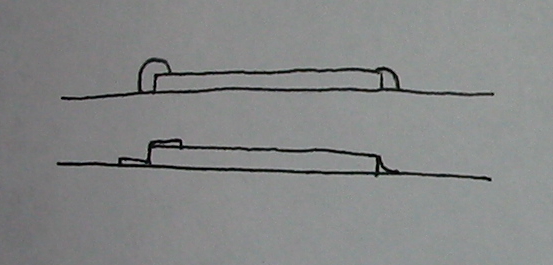
Note the outline at the top right

Note the outline at the top right

Taking a sidelong glance at a cutaway provides an illustration of properly positioned rings. On the top are rings which are excellent; just covering a portion of the coverslip and slide and presenting a significant barrier to oxygen infiltration or volatile compound escape. The example at the upper-left is representative of the sort of seal one is likely to find on antiquarian slides and is achieved by successive layers of cement or the use of a highly viscous cement. Asphalt varnishes or gum/rubber bearing shellacs will produce a ring of this character in a single application. The image at the upper-right is what one can expect of a properly located ring of gold size.

Below are rings which although correctly located will provide almost no protection. On the left one can see the product a ring which suffered for either being applied with too much pressure on the brush (just the faintest touch is needed) or with a cement of to low a viscosity, the thin cement spreading out because it was not substantial enough to support itself in the place of the force created by the spinning turntable. At the right one sees the cut-away of a ring that was applied without flowing freely from the brush. If the cement will not flow properly onto the slide one might need to first wet the brush in a small amount of the solvent to encourage a healthy flow. Another cause of rings of this sort is an unclean slide, which can result in rings that flow excessively or are seemingly repelled by the surface of the slide (depending on the nature of the contamination).

At some later time I will try to post some of the very serviceable sealing cements I have employed over the years and speak to the virtues and vices of each. For the time being I recommend those who desire an excellent all-around sealing cement stick with gold size as it is perfectly serviceable for most needs and of high quality. I must say that many cements available, at first seemingly excellent are much less impervious to the compounds apt to find their way onto a slide as it is used. Simply being available from a reputable supply house is not a proof of serviceability and one should never rely on an untested cement for a valuable preparation.
Ringing a Slide: Theory

I think it’s a great pity the commercial houses do not anymore seal slides in a fine varnish, but that’s just me. -K

Ringing a slide, just as often to be referred to as sealing a slide, was once a ubiquitous practice among not only amateur mounters but nearly all microscopists. The motivation for sealing a slide with any cover was preservation. Of course some permanent mounts were not required to last indefinitely and were not commonly ringed, but for some time seemingly every slide which bore a cover was sealed in some manner. Circular covers were ringed. Rectilinear covers were likely to be sealed as well but the methods were more apt to include waxes and methods that were less well known.

If one has had the opportunity to examine slides of significant age, particularly those that were never sealed, one may have noticed that the mountant is no longer the water-clear of a fresh balsam mount. All balsam will exhibit some tendency to darken over time, some more than others. Balsams that have had their volatile oils driven off and replaced with an alternative solvent may yellow more or less depending on that solvent; Benzene more than, Xylene and Xylene in turn more than turpentine. Other factors are at play as well such as the clearer used or the perfectness of the specimens dehydration. Some more simple factors may be at play as well, for example more acidic balsam tends to oxidize to a greater extent than so called neutral-balsam mounts.

Which brings us to the root of all the yellowing: oxidization. The infiltration of oxygen is the cause of yellowing in many mounts, be they damar, balsam or what have you. This is why then one observes yellowing in a mount it invariably encroaches from the edges of an in-tact cover (or an air bubble) and is more pronounced on the limits of the cover. To prevent the encroach of oxygen and retain the refractive index of the mountant it is necessary to seal the cover. Wax, goldsize, varnish, enamel, even rubber and gold leaf have been employed to seal the borders of coverslips with more or less success.

As a mountant cures the volatile components escape from the edges and the mountant solidifies. Initially the solidification of the mountant at the edges results in a coverslip which seems solidly bound to the slip. If an inattentive microscopists should accidentally rack down an objective too far and crash into and break the coverslip of a slide, the microscopist may be surprised to find that the mountant remains somewhat liquid deep within the mount, even years post preparation. The mountant will not generally begin to yellow as a result of oxygen infiltration until such time as the volatile compounds are exhausted. With many mountants the last of those volatile compounds will not be driven off until long after the mountant is solid.

This is the reason one may have heard that rapidly cured slides are more brittle than slides which are allowed to cure slowly at low temperature. A slide cured rapidly at high temperature is able to exude more completely its volatile components because although it must still escape from the edges of the cover those edges remain more fluid (gas permeable) due to the heat applied. For a quick demonstration one may place a drop of balsam uncovered on one end of a slip and a second covered with a coverslip on the other end of the slide. If this slide is left for several hours on a low temperature hotplate one will notice the uncovered drop (which should flatten nicely) is noticably yellowed and the balsam beneath the coverslip remains quite clear.

When sealed the mountant is prevented from venting it’s last remaining volatile components and retains it’s original appearance for far longer. The substances used to seal a coverslip are effective because they are not covered by a coverslip and so very quickly solidify and create a barrier to oxygen and the escape of the remaining volatile components of the mountant. For this reason sealants which are composed of substances very similar, even thinned with the same solvent as the mountant, may still provide acceptable results.

Some mountants (Euparal for instance) will not oxidize over time and do not need to be sealed to preserve their original appearance. The sealing of mounts may also be done for aesthetic reasons only. Layers of sealant in contrasting colors may be built up around the borders of a cover to great effect and a simple black ring may often prevent the inattentive from placing an unlabled slide upside-down upon a stage. In the end, sealing a slide may be a matter of superficial preference or a means of ensuring ones slides endure in superior condition for future generations. In the next installment we’ll take a practical look at slide ringing.

Rapid Process Mounting

Sorry for the lack of updates, the summer is always a less leisurely time than one expects. -K

When last macerated and pressed mounts were mentioned the method employed required a long weekend at a minimum, but the entire process can be done in a day. Some people will appreciate progressing from specimen collection to finished slide so rapidly and some are sure to prefer the day by day process of a longer method. For the summer months when both specimen availability and social obligations are at a peak, the following entries from my notes may prove welcome. Embellishments not appearing in my notes but provided here for clarity appear in parenthesis:

8 Jun. ’14 10:00am Captured 5 spiders from under the addition. Collected them into stoppered test tubes finding it easier than Mason jars (a flat of small jelly jars often makes up my collecting kit when working in the garden). Three of the spiders are larger and of orange hue which leads me to identify them as males of the common house spider. Two despite being smaller I take as females of the same species. (The description in the Audubon field guide describing males as orange and smaller than females, while Comstock elaborates at the striking variety of forms exhibited by the species and its tendency for differing specimens to be taken for differing species by novices. The habitat and cohabitating species contribute to my identification.)

Killed them by introducing Ether soaked cotton swabs to the test tubes. One stopper was ejected by the expanding gas and I feel a better poison will need to be collected (for use with this method I imagine chloroform will prove superior and more desirable than for instance, ethyl acetate, as speed is a factor).

11:18am Have processed the three males through to the pressing jar. Each was boiled in 3ml of 10% NaOH until quite transparent. (The test tubes into which the spiders were initially collected were used and heated over an alcohol burner. When doing so the test tube should be slightly tilted to face away from the preparer and towards bare floor or table to minimize danger in the case of bumping. Agitating the test tube slightly and holding over rather than in the flame will also help to prevent bumping.) The solution was then drawn off and aprox(imately) twice the volume of distilled water added to the test tube. Into this was placed several drops of glacial acetic acid until diffusion currents were no longer observed. The solution was then poured off and replaced w(i)t(h) aprox(imately) 2ml of distilled water.with a rubber stopper inserted the specimen was swirled in the tube until near the mouth and then rolled to be on the side away from the water adherent to the side of the tube. With the stopper removed the tube was manipulated so as to wash the specimen into a Syracuse glass.

(Here in my notes is a sketch depicting the motions required to carry the spider from the test tube with such a small amount of water. It is of course simpler to simply employ a larger volume of water but then it requires a larger Syracuse and in the end more potential for spillage. The ease of adding a sketch to handwritten notes is reason enough for me to never adopt an electronic medium for note taking.)

The females were placed into a Syracuse in the vacuum desiccator together with a jar of Drierite to await processing after the males are completed. (I try to work with specimens of a single type only at one time for the sake of simplicity. It’s far easier than one might expect to mix things up when working with only five specimens.)

(After a lite lunch with my wife, which gave the alcohol sufficient time to harden and dehydrate the specimens, I returned.)

1:50pm Removed pressed males and transfered them through to clove oil one by one. Find the first macerated to be a bit to opaque and hope the clearer will improve its appearance. All removed intact and came away from pressing slips without incident. (I use slips of the cheapest sort for pressing and some are never quite clean enough-or smooth enough-to release the specimens without damage. The cheap slips is a compromise I make for budgetary reasons as the spring clips which I use to hold the pressing slips together can be quite hard on the slips.)

2:45pm Mounted the males on plain beveled edge slips from Ted Pella in balsam under 22×35 Gold Seal covers. (I quite like the plain economy slips from Ted Pella, the beveled edges decrease immensely the tendency of chips to form when used on spring loaded mechanical stages.) One specimen became far off center and the cover was lifted and the specimen repositioned under a new glass, a leg was separated in the process but was left in approximately proper posit(ion). (Misplacement of specimens can be upsetting but unless it approaches the edge of the cover should be overlooked as the risk of damage is quite large once the balsam has begun to penetrate the specimen. I properly should have placed the whole into xylene to dissolve the balsam and then remounted as normal but with several specimens on hand I become less careful than I should be.)

3:12pm Slides placed in attic to cure. (If more rapid curing is required a cool oven or hot plate on very low setting can set the mountant nicely in a few hours. I prefer the heat of the attic of my home during summer as the hot [32-35C] dry [below 5% RH] attic cures slowly enough to permit even the largest and deepest air bubbles time to escape.)


Uncut Pages and Antique Microscope Books

Microscopy has been around long enough to build up a colorful and vibrant history, the new works produced every year is poor excuse for neglecting the past. -K

The present condition of publishing is such that I will always recommend one starting out with the microscope look to the past for their first text. Modern works have a distinct tendancy to be disapointingly basic or profroundly technical. In the latter case far too expensive for someone trying the hobby on for size-a fault of a great many textbooks. At the turn of the century microscopy as a hobby (and potential future career) was in a sort of golden age as far as publishing went. So much so that today a fair few professionals remember fondly the works for people like Philip Henry Gosse and Thomas Davies.

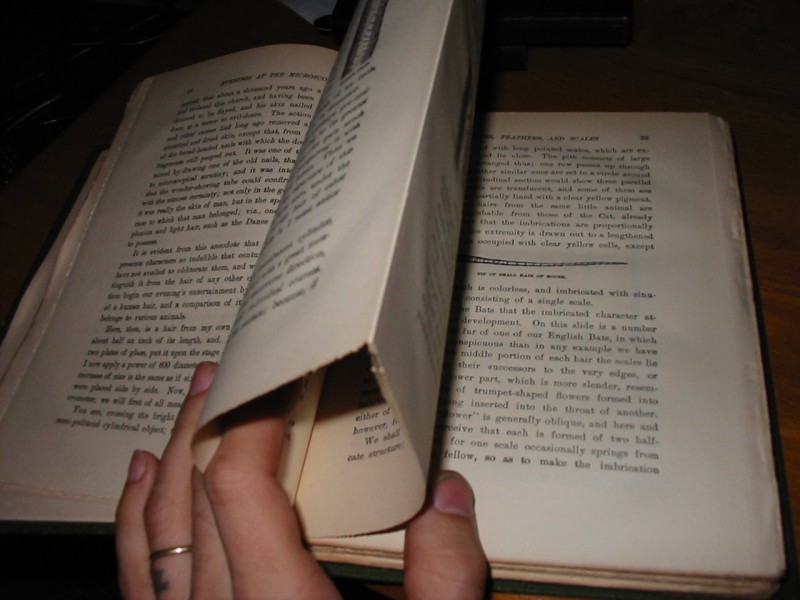
When buying a work that was as widely available as-for example-Gosse’s Evenings at the Microscope, the most economical option is as often as not a book that may well be far older than the purchaser is used too. Old books are quite unlike those of today, just ask an enthusiast. In any case if one happens to purchase an antique microscopy text one may encounter something odd; uncut pages. The uncut page is a not infrequently found in antiquarian books and together with ragged edges is not anything one should be overly concerned with. In the copy of Evenings at the Microscope shown below a great many pages are uncut, and we may well reason that this book, published in 1902, has never been read.

An example of uncut pages.

An example of uncut pages.

In order to make use of the book the uncut pages will need to be opened by cutting through them at the crease. If this was 1902 and the book were new one might simply pull out ones pen-knife whenever necessary and carry on reading. Today the paper is apt to have been somewhat oxidized and the risk of errant cuts thereby somewhat increased so that greater care is required. For my part I prefer to use a sharp (but not recently honed) straight-razor style section cutter, it works nicely and seems rather fitting. Whatever knife is used when cutting keep the blade only slightly off from parallel with the crease and make a small sawing motion rather than a slice to minimize the risk of damage to the pages.

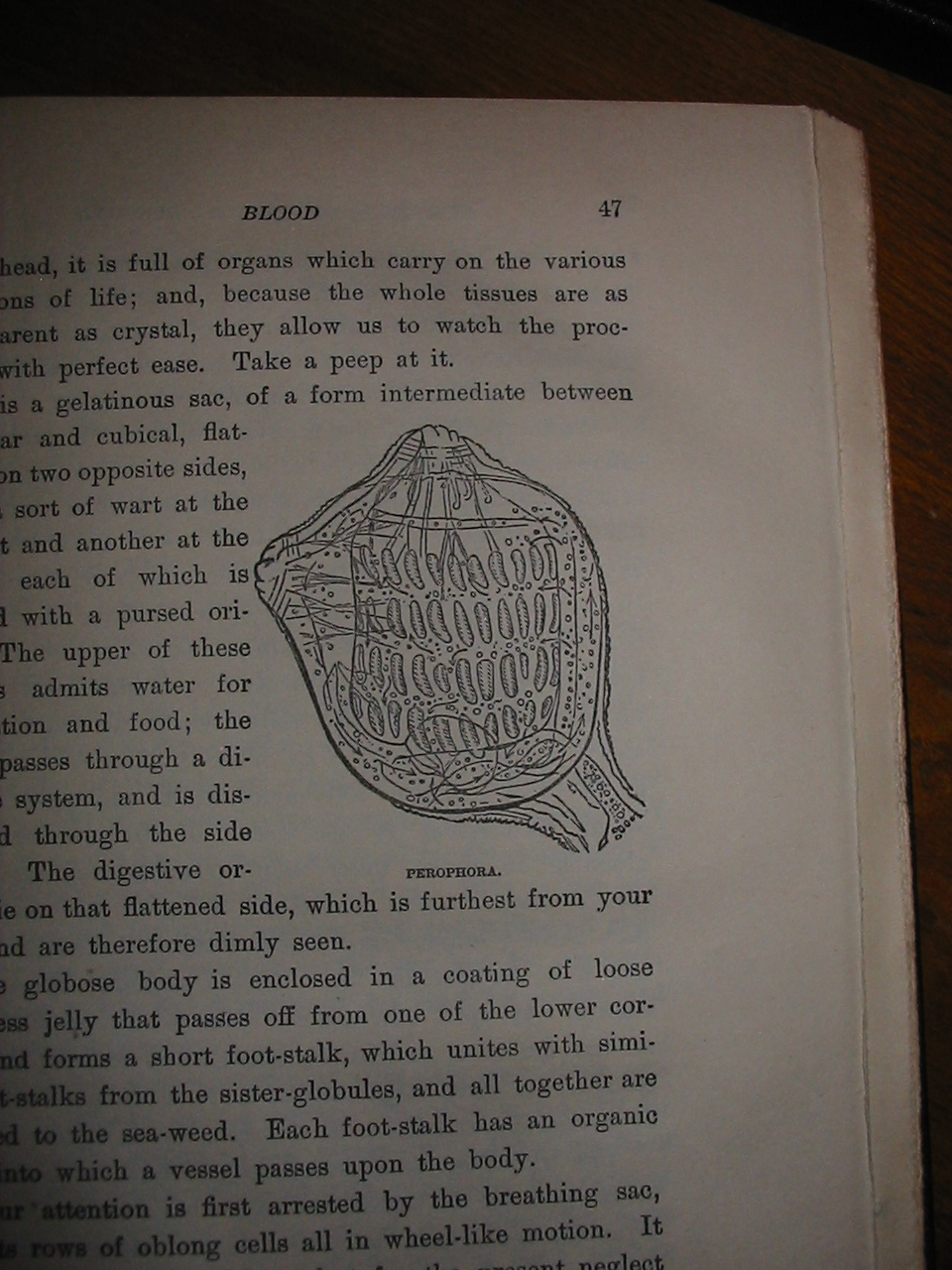
The community of antiquarian book enthusiasts is somewhat at odds as to whether cutting the pages affects the value of a book, but for the most part the value of the microscopy texts one encounters that have uncut pages is likely to be small in any case. So should one encounter a book with uncut pages when reading up on things microscopic, by all means open those pages and show them the light of day! I am the first to see this precise illustration of a Perophora in 112 years!

Image

Simple Crystals

Some crystals are rather pitiful without the use of polarized light, but that’s best left for another time. -K

Crystals are a fine object for the microscope and few are the beginners texts which do not direct the observations of one sort of crystal or an other. By far the most common directive is to create a saturated solution of salt (sodium chloride) and placing a drop on a clean slip observe the process of crystalization as the water evaporates. Interesting enough as an activity, but not as enlightening as it might be. Occasional one might be directed to try kosher or even rock salt and compare it to iodized table salt, but even then a salt crystal is a salt crystal and one is apt to find it dull.

If one has been diligently preparing insects via the maceration and pressure method one will have on hand a solution that makes a rather more interesting crystal. The sodium hydroxide or potassium hydroxide one has been using to macerate insects may be deposited in the center of a slide in a small drop and put aside under a cover to dry. There’s no need to prepare a saturated solution, yet, but in a short time the liquid will evaporate and one will have a delightful snow-flake like crystal to observe.

Naturally having created a fine crystal one will desire to keep it. The slide might be retained as it is, without a mountant or coverslip, indefinitely. It is much better to use a coverslip and create a more secure slide. One may think that upon application of a liquid mountant the crystal will immediately dissolve and be lost, occasionally this will be the case, but then there are always other mountants and methods one may employ. Try mounting a sodium hydroxide crystal under natural balsam; is the result different if xylol balsam is used? Is the result different for Euparal or Damar, for Nu-Mount or Hyrax? If the crystal proves to be soluble in all of the mountants one posses it may still be secured under a cover by a method that is becoming increasingly uncommon, the thin cell mount (to be covered in an upcoming post).

Once one has the hang of creating a simple crystal mount certain questions may come to mind concerning their form. Before running to the nearest chemical handbook, I would recommend trying to answer a few questions by practical experiment:

  1. Does a different concentration of chemical yield a different form of crystal? (10% vs. saturated for example.)
  2. Does a different temperature or speed of crystallization? (Place the slide upon a hot-plate, or in a freezer.)
  3. Does a different solvent? (There’s water, but what of the other solvents, isopropyl and ethyl alcohol are likely on hand.)

Afterwards run off and see if the results are congruent with what is shown in a chemical text, then wonder at the career you might have enjoyed in chemical analysis. This is of course the most basic sort of crystal mount one may make but the idea is to discover a new object for microscopy and many owners of the microscope will have never examined anything beyond the world in a drop of water.