Box Camera Photomicrography

Don’t follow my advice on developing, I know microscopes; not photography. -K

Of all the books on photomicrography perhaps the most in depth is that written by Dr. Roy M. Allen. As technical as it is the book is not without its own charm. Buried in a footnote, Dr. Allen relates his first attempt at photomicrography as a child in the late 19th century. He made his images with a box camera, using the sun for illumination.

Having a box camera on hand, I thought I might give the process a try. The camera is an Agfa Ansco Shur-Shot B2 manufactured a few towns over from me in Binghamton, New York back in the 1930’s. It’s a wonderful camera for this, shooting widely available 120 film and featuring a shutter that provides for both short (approximately 1/50th) and long (B style) exposures. Unfortunately, the cameras lens is a hyperfocal meniscus lens that is less than optimum for photomicrography. A quick examination showed that the lens was held in by a simple tension ring and could be easily removed without causing any damage.

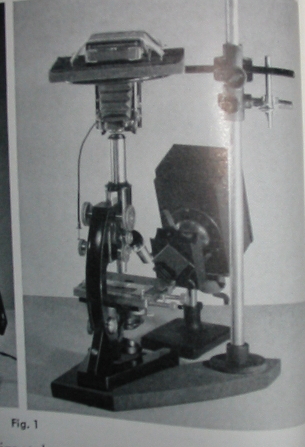
Using a lab jack made elevating the camera to the microscopes eyepiece very simple, though a stack of books could do just as well. A bright illuminator (a halogen lamp by B&L) that dates to the same period as the microscope and the camera, rounds out the setup. By using such a bright illuminator I hoped to keep the exposures short and avoid the vibration of operating a manual shutter.

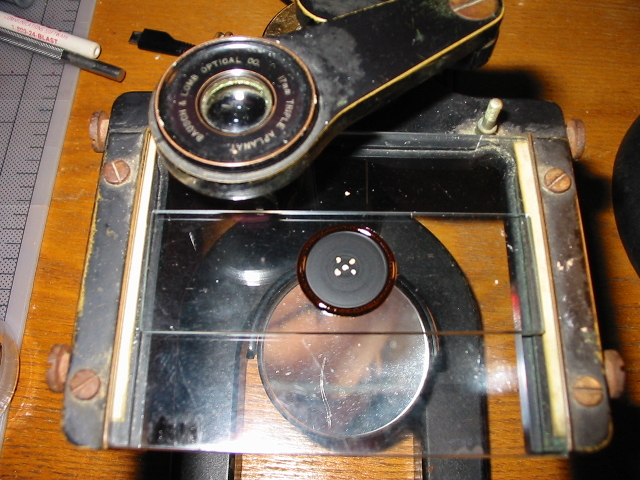
The low power magnification didn't require a condensor so a stand with a simple disc substage was used.

The low power magnification didn’t require a condenser so a stand with a simple disc substage was used.

The depth of the box is less than 147mm, so photo and projection eyepieces are out, and a standard 5x Huygenian eyepiece was used. Thankfully, spherical aberration was less than I might have expected using achromatic objectives and a bellows length of less than 125mm. As box cameras have ground-glass view finders that are independent of the lens, (the two circular lenses seen on the right of the camera above) focusing can not be done through the camera once film is loaded. Prior to loading one may hold a paper or ground glass at the rear of the camera to determine the size of the image formed. A simple paper tube covered at one end and having a length equal to the distance from the cameras shutter to the film, serves as a focusing screen. Exposures are made by focusing with the tube and then replacing it with the camera and depressing the shutter.
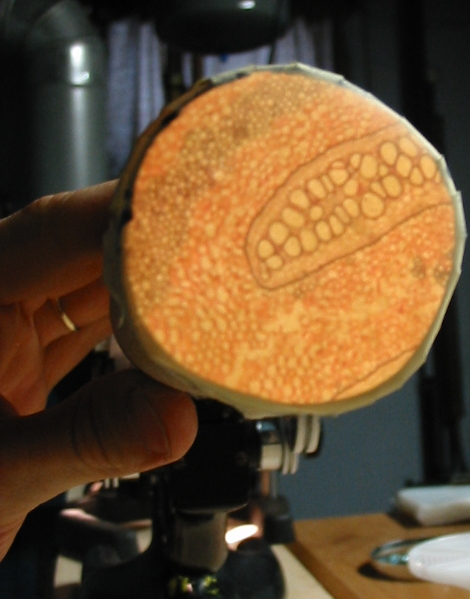
An image as seen though the focusing tube.

An image as seen though the focusing tube.

With the film loaded into the camera and the intended slides at hand it is only a few minutes before I have a roll of B&W 120 film ready for developing.

After loading the film onto a reel and placing it into a developing tank in a changing bag, I processed it for 15 minutes with Pyro-Metol Kodalk followed by a plain water stop bath. Next the developer was poured into a beaker and the fixer went into the tank for six minutes. I used an alkali rapid fixer known as TF-4. Following the fixer, the film (now safe to expose to light) went into the used developer for two minutes prior to a 30 minutes wash.

Presto! A roll of 8 photomicrographic negatives having the classic circular aspect and clarity of medium format. Each negative image measures 45mm in diameter. All in all, the results seem rather nice considering the film I used was some Kodak T-Max 100 that expired back in the mid 1980’s and came to me via eBay for just a few dollars.

The question now is whether to get a negative scanner or a darkroom for making prints.
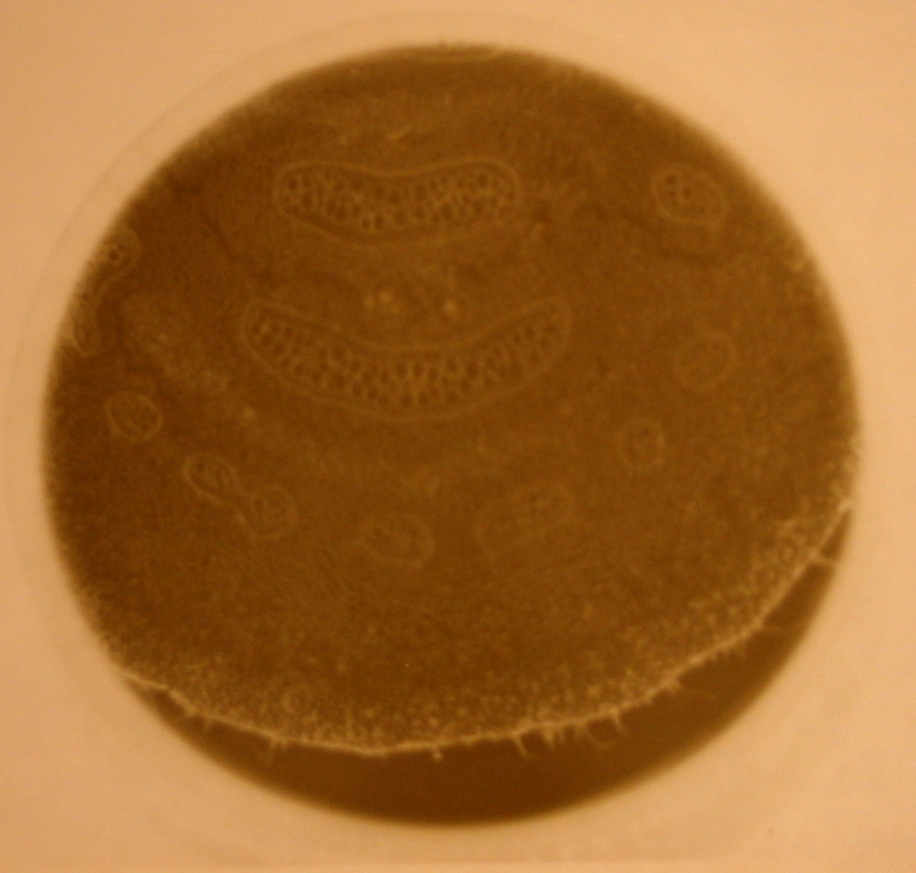
The digital photo does not do the clarity of this negative justice.
The digital photo does not do the clarity of this negative justice.
Elucidating Integral-lens photomicrographs

Preventing Obscurity

Once a photomicrograph is produced, one may desire to know some basic information regarding it; for example the scale of reproduction, or degree of magnification. To calculate most information only a little simple math is required. The formula for determining the scale of reproduction when using a camera with an integral-lens as follows:

Scale of reproduction = Objective magnification x Eyepiece magnification x Focal length of lens / 250

The formula works because the product of objective and eyepiece provides the initial base magnification, while the second portion of the equation provides the degree of reduction effected by the cameras optics. The lens will provide some level of reduction, unless it has a focal length equal to or greater than 250mm, which is expressed as the quotient of its focal length (in millimeters) and 250. The divisor in this case comes from the distance at which the virtual image is produced by the microscope expressed in millimeters.

The authors lens has a fixed focal length of 55mm, (which will provide a reduction of approximately 1/5) meaning that a 10x objective and ocular will produce a photomicrograph presenting with a magnification of 22x. To determine the accuracy of the calculation [or when using cameras with lenses of unknown focal length] one may measure the field of view visually with a stage micrometer (in this case measured at 150μ), and again as reproduced on the photomicrograph (measured at 63μ) and calculate the practical factor of reduction or effective magnification of the photomicrograph (23x which bears out the accuracy of the previous calculation).

Many consumer digital camera carry a lens with a variable focal length of from 2-25mm and this may be set by the user in manual mode, or determined after the fact by reading the exif data of the digital image.

For most focal lengths one will discover that the entire photosensitive surface is filled, be it 35mm film or a digital sensor. As a result only a portion of the microscopes field of view will be recorded. This effect will surprise some technicians who may expect to capture photomicrographs that are circular, just as the field of view is. Theoretically, to capture a more complete image of the field of view presented by the eyepiece, one may employ a lens having a shorter focal length. To determine the lens focal length that will provide the ability to capture the entire field of view one must know the nominal size of the field of view provided by the microscope eyepiece in use as well as the size of the imaging surface.

The rectangular sensor of the authors Nikon 1 J1 digital camera is 13.2mm by 8.8mm giving it a hypotenuse of 15.8mm. To entirely fill the sensor area, and produce a rectangular photomicrograph, while still imaging the largest portion of the field one will use the sensors longest dimension in the following formula. To image the majority of the field use the smallest dimension. The field of view index may be determined in a general way by measuring the field diaphragm of the ocular employed, it may be inscribed on modern oculars as a number following the inscribed power.

The imaged areas hypotenuse is equal to the sensors hypotenuse divided by the index of the field of view provided by the eyepiece.

Sensor dimension / Field of view index = Visible image diameter

This equation should well illustrate that a significant change in the scale of reproduction as effected by the cameras lens, will in essence, spread the photosensitive surface over a larger portion of the field of view. Doing so, will serve to reduce the resolution of the photomicrograph. So it is best then to use the above equation only to describe the power of magnification inherent in the image. With the above information one may mark a photomicrograph with a line and appropriately label its length with ease. Micrographs are best provided with this marking as it then acurately provides information on the size of imaged structures and magnification independent of the size at which the image is produced as a print.

Suffice to say that if one desires to image the whole of the visual field without introducing significant aberration or image degradation the simplest and best method is to operate a camera with a very large photosensitive area. One may consider that most of the historic photomicrographs (especially those presenting a circular field) were produced on plates or films considerably larger than 2.25 by 3.25 inches which is quite a bit larger than most widely available film or digital sensors.

What is the take away from all of this? Consider alternatives to the use of an integral-lens camera if one needs to produce an image having particular magnification or field coverage. Use the above to determine the characteristics of the photomicrographs one does produce and strive to take superior images with the equipment one possesses.

Photomicrography with Integral-lens Cameras

Don’t forget to renew (or begin) your membership in the Royal Microscopical Society before the 31st to ensure an uninterrupted full-year of membership. -K

Many of the primary faults of compromise photomicrography can be eliminated by simple means. Various apparatus may be purchased or crafted that contribute to success, and because of the ingenuity of microscopists the apparatus will not be expounded in any detail. Instead, the topic will be methods of producing optimum images when using a consumer grade digital or film camera which has a lens, but first permit an explanation of the chief faults of the method: vignetting, and obscurity.

A vignetted image is caused by the obstruction of a portion of the image by an aperture. The aperture may be within the cameras lens, the microscopes ocular, the body tube, or even condenser of the microscope. Most vignetting may be eliminated by ensuring the camera (and its lens) are aligned with the optical axis of the microscope, and the remainder by setting the lens of the camera properly as regards focus and the size of its aperture.

By obscurity one means the lack of precision regarding the photomicrographers knowledge of the image captured. When using a commercial apparatus one is aware of many things regarding the image because the manufacturer provides that information. When using a compromise apparatus one may be at a loss in determining the scale of the photomicrograph or even its degree of magnification, for example.

Preventing Vignetting

For optimum results one must position the camera so that the lens takes the place that would be occupied in normal operation by the eye of the microscopist. This means that not only should the camera share an optical axis with the microscope but that the initial optical component of the lens must be placed at the eye-point (exit pupil) of the microscopes ocular. In normal visual operation one finds this point instinctively by simply moving their head until the best image is observed by the eye. For photomicrographic use one may find the position of the exit pupil by holding a piece of index card over the eyepiece of the focused microscope. Move the card towards or away from eyepiece until the point of light seen on the card is smallest and then measure the height of the card over the eyepiece. The writers 10x B&L ocular produces its exit pupil at 5mm.

In operation a camera is focused on an object based on the distance of that object from the camera. In photomicrography, the object photographed is at a constant and known distance regardless of the ocular or objective in use. By design this distance is that of the eye at relaxed focus on an object as seen at 25cm (or 10 inches) distant-relaxed focus of the eye being equivalent to an optical system focused at infinity. Hence the oft made admonition that one should look through the microscope with eyes relaxed, rather than into the microscope with eyes strained. As such one should place an auto-focus camera in manual and set the focus to infinity (100feet or 30.5meters on some cameras). A manual focus lens should be set at infinity as well.

If the lens of the camera is then placed at the exit pupil of the focused microscope, no additional focusing of the microscope should be necessary to produce a sharp photomicrograph. This is particularly relevant if one is using a film camera (or digital camera without an LCD) as the cameras prism is unlikely to prove operational in this context. It is also relevant as the display of a digital camera will generally lack the resolution to ensure sharp focus. Following the above recommendation some microscopists may discover that they are in the habit of accommodating their vision for different focal distances when using the microscope. Young individuals in particular are likely to find this condition and can determine the degree of accommodation by focusing the microscope and then manipulating the focus of the cameras lens until a sharp photomicrograph is produced. A similar situation is apt to be experienced by those who wear eye-glasses and are in the habit of removing them when operating the microscope-one may discover if this is the case by focusing with eye-glasses on and then observing the sharpness of the image with eye-glasses removed.

Following the above methods, one is unlikely to experience vignetting. If it is still observed and can not be eliminated by altering the alignment of the camera to the microscope, it is apt to be attributable to the size of the camera lenses aperture. One must ensure that the camera lenses aperture is equal in size to, or larger than, the exit pupil produced by the ocular employed. With film cameras one should always employ the largest aperture opening available both to eliminate vignetting and to ensure that the image captured on film is illuminated consistently and does not dim towards the borders of the field of view.

This is getting rather long so eliminating some of the unknowns inherent in compromise photomicrography will be discussed in the next post. -K

Compromise photomicrography

There is no reason to run out and buy anything, for the below I used only what was already on hand. -K

Provided one has a microscope and a camera, no additional equipment is absolutely required. In a pinch a photomicrograph may be produced by holding it to the eyepiece and hoping for the best. Some simple steps may be taken to ensure the best possible result of this slipshod technique. The chief argument against holding a camera to the eyepiece is that the stability of ones hands is not so reliable as one might prefer. Overcoming this difficulty is not so complex as it may first seem.

The microscopists eye replaced with a consumer grade 35mm camera.

The microscopists eye replaced with a consumer grade 35mm camera.

In a slim text titled Photomicrography put out by the Eastman Kodak Company an excellent method of positioning a camera at the eyepiece is illustrated. In the text it is recommended that one fabricate a simple wooden board with an appropriately sized hole to accommodate the lens of ones camera. Once placed through the board the body of the camera is held firmly in place by rubber bands. The whole is then suspended over the microscope on a standard laboratory ring stand so that the lens of the camera corresponds with the eye-point of the objective.

Once the microscope is focused normally, the camera may be swung into position. On some varieties of camera the regular sight would then be used to verify focus, or a ground glass focusing plate might be substituted for the regular camera back. The large digital displays of modern cameras provide an added convenience when it comes to focusing, and widely available software for tethered camera control as well as wireless remotes eliminate the risk of misalignment during exposure. Additionally, the absence of any mechanical shutter eliminates a common source of vibration which was the bane of many an amateur photomicrographer.

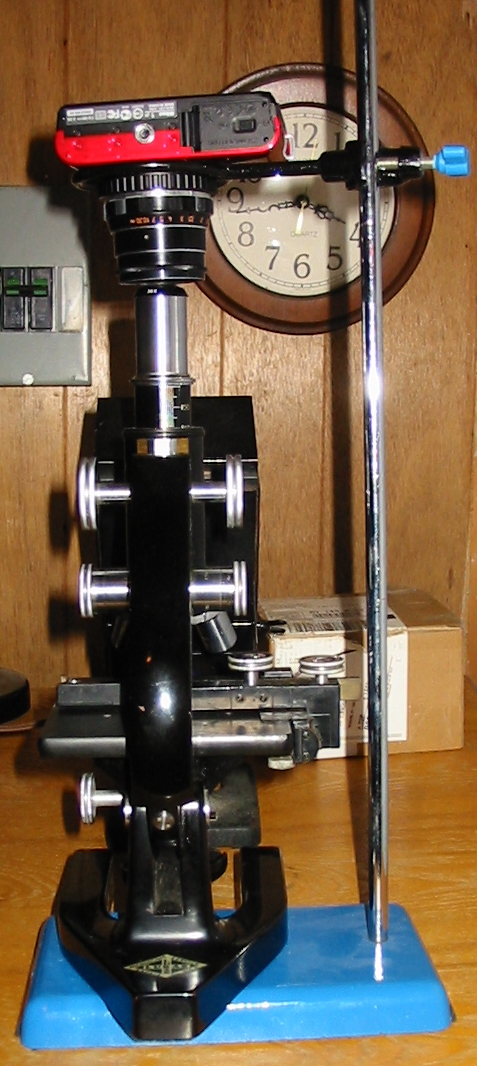
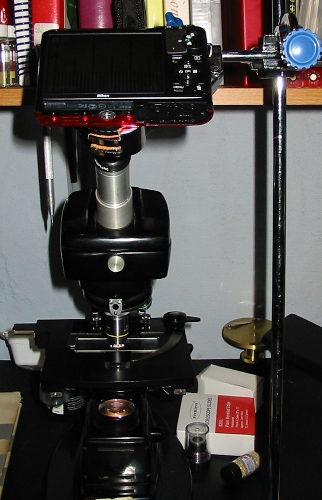
With a ring stand it was the work of a moment to position a camera over the eyepiece of a microscope oriented fully vertical. If one did not have a ring stand or similar support on hand, one might easily utilize a standard photographic tripod towards the same end. Adapting the method for use with a microscope with a permanently inclined eyepiece (such as the B&L Dynoptic, pictured below right) required no more effort than trading the ring support for a utility clamp mounted on an intermediate boss-head.

Vertical microscope with ring supported digital camera.

Vertical microscope with ring supported digital camera.

Considering briefly, one might see how this same general method could be adapted for use by an individual possessed of nothing but a standard microscope and camera. Manipulating the microscope so that it is fully horizontal permits simply sitting ones camera on any convenient support that will elevate it to the height of the eyepiece.

Fixed angle microscope with camera held at apropriate angle.

Fixed angle microscope with camera held at appropriate angle.

Presently, all manner of custom mounts and accessories have been manufactured and marketed to the amateur that simplify arranging and aligning photographic apparatus-from cellular phones to expensive DSLR’s-at the eyepiece of any optical equipment from microscope to telescope. Such equipment is largely unnecessary as has been demonstrated above.

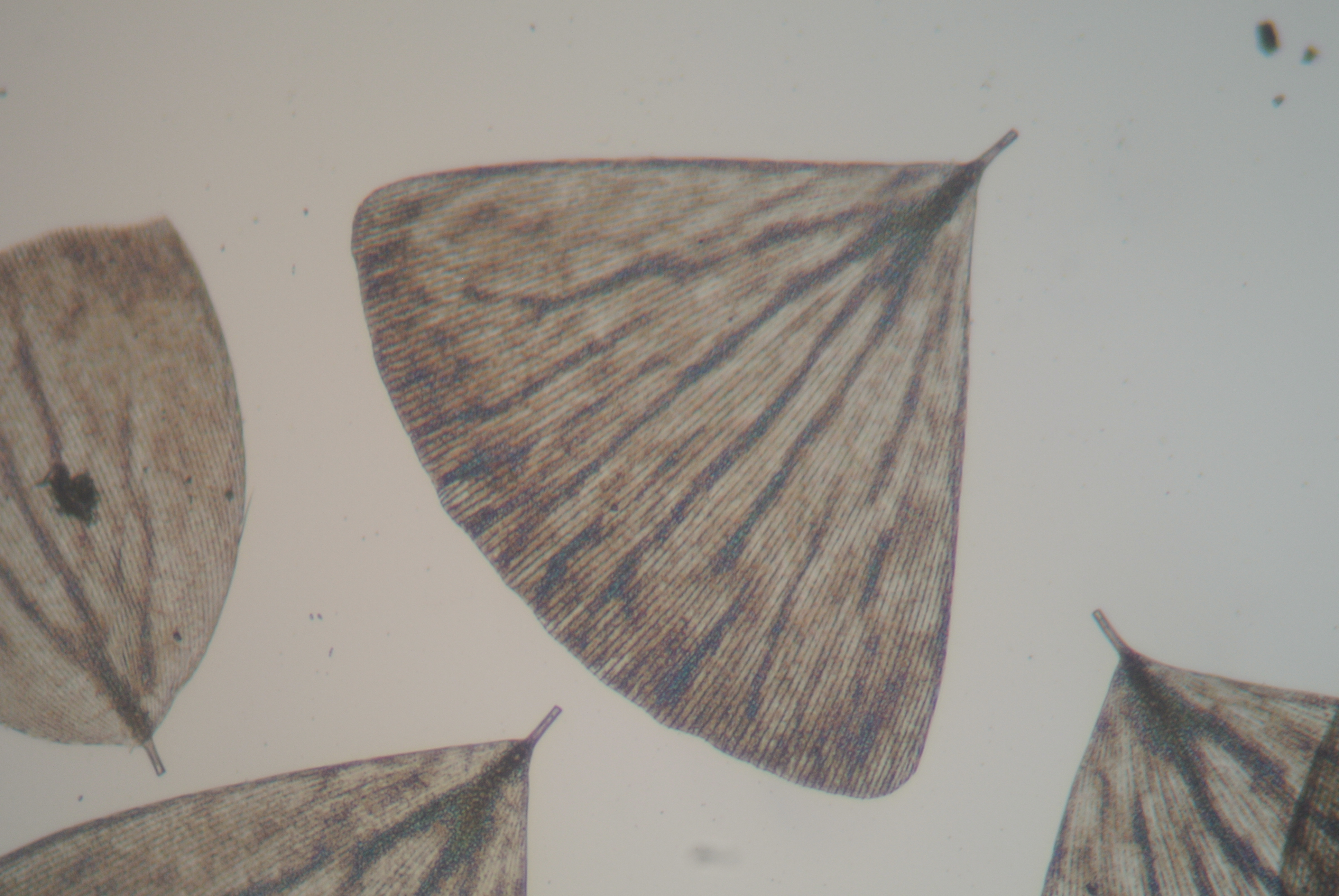
But are the images produced by this method acceptable? Without specialized equipment or complex software the below image was produced. In all it took longer to walk to the shelf on which the ring stand was stored than it did to arrange the equipment and take the photomicrograph. In the image below one can see that ample room for improvement exist. Having lately been playing around with an old Russian range-finder lens which was mounted to a Nikon 1 J1 body, it was the camera used. Looking at the lens afterwards I note that it was focused to about 10.5 meters and the aperture was fully open. In any case below is the image produced of a traditional test object for low powers, the scales of a butterfly, as seen with a 10x objective and 10x ocular.

Be warned the full size image is ~4MB.

Be warned the full size image is ~4MB.

In the next post methods of achieving optimum image formation with the above method will be discussed.

Cameras!

Photography is as allied with microscopy as could be, so do forgive this. -K

There was a time when possession of a microscope was a rare and novel thing. However rare it may be, it is certainly no longer novel. The same might have once been said of the photographic camera, but in the present day it might be more rare to encounter one who does not possess a camera. With the proliferation of cellular smart-phones it may seem that everyone is in constant possession of camera. This situation is apt to elicit a particular behavior; the placement of a camera at the eyepiece of a microscope.

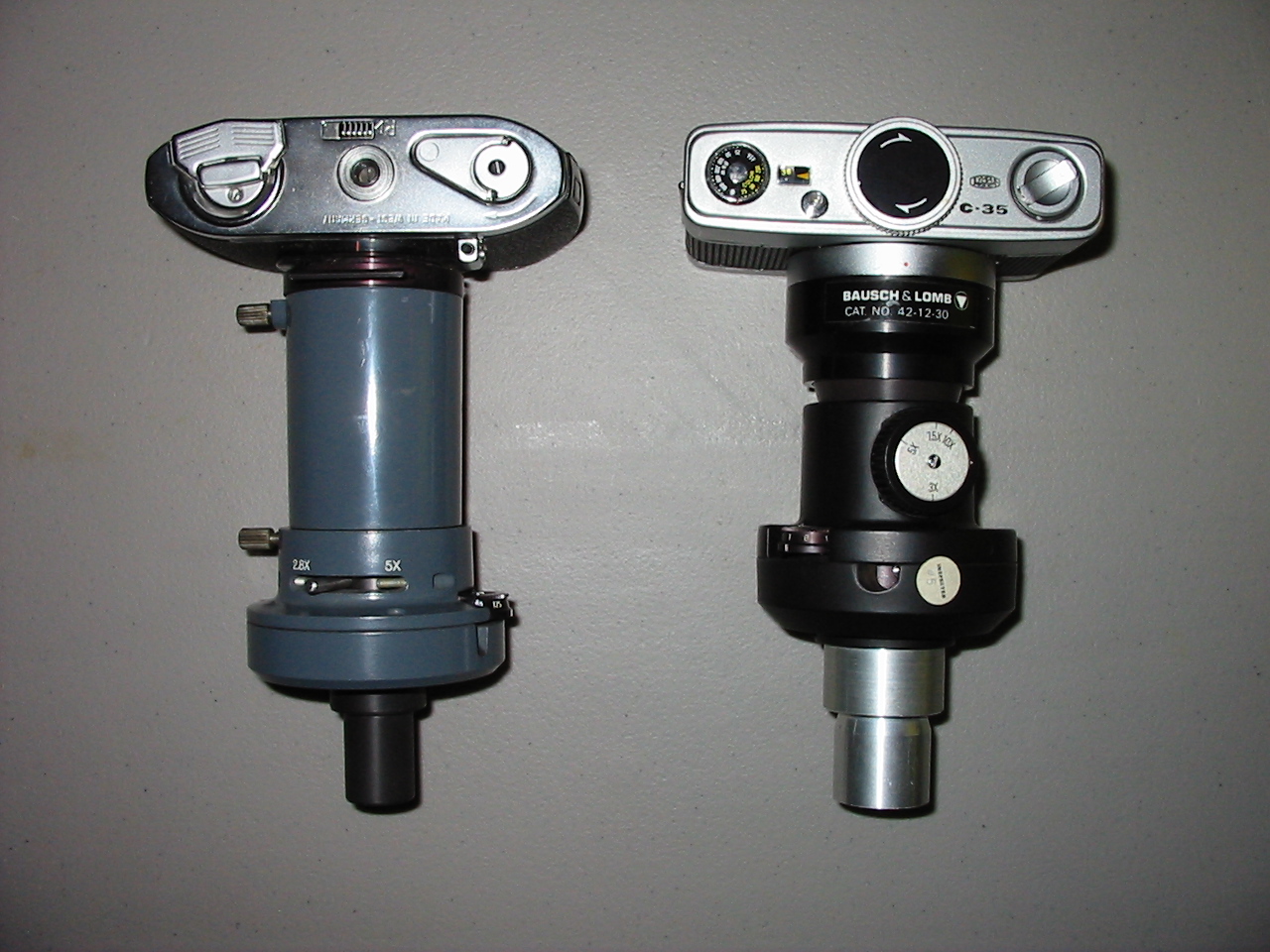
Initially existing photographic apparatus was adapted to the microscope by the operator to meet their individual tastes and needs. Before long, manufacturers began putting out specialty photographic apparatus intended to be placed at the eyepiece of the microscope. Sometime later specialty microscopic apparatus-possessed of a beam splitter and photo tube-that required even more specialized photographic apparatus became the standard, below are two 35mm cameras of that sort.

Two varieties of integrated photomicrographic apparatus.

Two varieties of integrated photomicrographic apparatus.

Simple, and easy to use, versatile cameras like the above provide variable levels of tertiary magnification. Shutters are integrated and fittings for remote shutter release are provided, along with connections for automated exposure meters, and on some models other computerized accessories. Unfortunately, these sorts of camera are very non-standardized. One might notice that the lower optical connection on the above are of significantly different size, neither compatible with any of the standard eyepiece diameters. Apparatus of this type is only suited for use with microscopes equipped with a photographic head, and even then one can not be certain of physical-never mind optical-compatibility.

Modern stands equipped with photographic apparatus are frequently of questionable quality and universally expensive. Vintage stands tend to be incomplete and similarly expensive. Unless one is lucky or particularly knowledgeable this sort of apparatus is best pursued only cautiously. Instead, one might take a page from the microscopists of years ago and seek to adapt standard photographic apparatus to photomicrographic work.

The next few posts will treat with this topic with a goal of producing professional quality photomicrogaphs conveniently and usefully. If this goal may be reached economically in a manner that provides optically superior results it is only because of the countless microscopists who labored with cumbersome tools and complex arrangements  to provide our understanding of the required techniques.

Practical Alignment: Objectives

Objectives are too sensitive to be manhandled by the novice, their mounts however… -K

Modern stands, particularly those intended for student use, at first seem to lack provision for adjusting the objective to improve alignment or centering. This is not any great failure, quality manufacturers produce stands that are near enough to alignment as designed that they might suffer a large amount of mishandling. If one is using a new stand, adjustment will likely be unnecessary. If one has a used stand, one should first check their alignment before making any adjustment. Luckily, identifying misaligned objectives is a simple matter.

All but the oldest and most basic stands will have a simple provision for rapidly changing objectives, a rotating nose-piece is most common. Such a nose-piece provides a rapid method of identifying if alignment is acceptable or not. To make the determination one need only place a prepared slide (a stained blood smear is well suited to the task as one may position an easily recognizable white blood cell in the center, a stage micrometer or other calibration slide would also be highly precise) on the stage and bring it to sharp focus with a particular objective. One will then take care in positioning just in the center of the field of view some conspicuous portion of the specimen. Upon switching to the next objective in the changer the conspicuous portion of the specimen would ideally be still in the center of the field of view, it is never likely to be so.

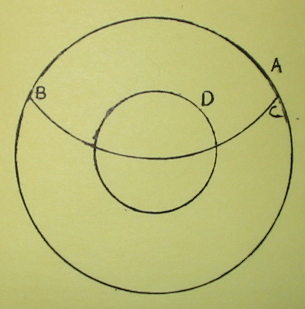
Perfection of positioning from objective to objective would only be possible should each individual optical component (every lens from light to eye) be precisely centered. Considering the number of individual lenses in each objective, one must accept that if the conspicuous portion is still in the central area of the field of view, the objective is centered. In figure one below, where circle A represents the field of view, one might be satisfied if the conspicuous object remains within the area of circle D from objective to objective.

IMG_1540scalecrop

Fig. 1

There are rotating nose-pieces where each objective mount is fully individually center-able, but they are few and far between; look instead to see if some less exact provision for adjustment is provided. On the Bausch & Lomb nose-piece seen below are small adjustable plaques that serve as positioning apparatus unique to each objective. Moving the position of the plaque moves the location at which the objective stops along arc B-C as depicted in figure one. Although it will not truly center the objective it can be used to position the circle D for each objective along arc B-C.

Positioning plaques and stop.

Positioning plaques and arm stop.

On many other rotating nose-pieces, plaques of the above sort are lacking. However, they operate on the same principle and the arm may be adjusted to achieve the same effect.

A final word of caution, one should focus on achieving the most perfect alignment with the most powerful objective one intends to use. By virtue of having the smallest field of view the most powerful objective will be the one most sensitive to adjustment.

Truly Traditional Mounts III

An ounce preparation is fine but a pound will go farther, so here’s hoping no one skipped the previous post. -K

Preparation

The following is only slightly different depending on the specimen/specimens to be mounted. In the case one may wish to mount objects beyond those described, the following may be helpful. Consider that what may be mounted in a dry cell is extensive but, in general all may be divided into three categories.

  1. Those which are adhered to the cover glass: diatoms and other very small delicate objects.
  2. Those which are adhered to the slip: small objects that may be damaged by moving about within the cell.
  3. Those which are loose within the cell: soil, sand, and portions of feather are the usual.

In this case, objects of the second variety are being utilized; specifically microfossils, but any other items failing into the same category may be used. Due to wide availability and comparatively large size, microfossils, micrometeorites, and other similar objects are an excellent first choice for one not yet acquainted with the technique. Whatever is selected, first see that it is prepared for mounting by ensuring it is totally dry and devoid of contaminating debris.

Mounting

Bausch and Lomb Dissecting microscope W

Bausch and Lomb Dissecting microscope W

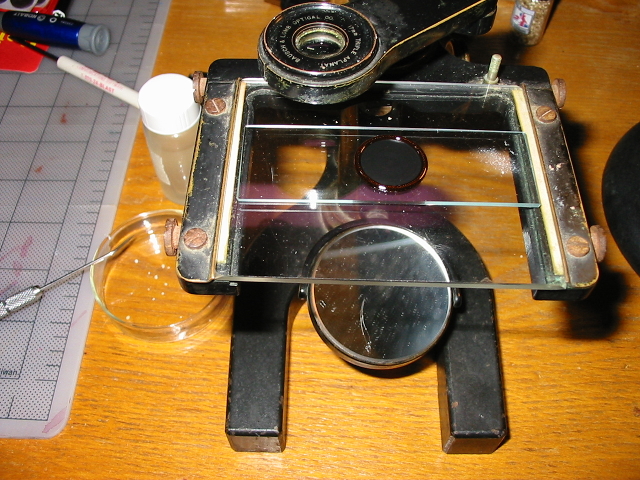
A petri dish, watch or Syracuse glass is useful for laying out objects. Select a quantity of objects which are of a size to fit beneath the cell vertically and lay them out (on a handy surface) in a pleasing or utilitarian way horizontally. Place the slip (with cell) near to the surface on which the specimens have been lain out; some will find a dissecting microscope or loupe useful if inherent vision merits. An old style dissecting microscope may be found suitable, as one may easily move the lens aside when it is not required.

Depending on the adhesive employed… Gum tragacanth is the finest choice so far as the author is concerned. It is inexpensive, sufficiently able to adhere most objects, of a quality to persist over time (as evidenced by historical use), and is hydrophilic enough that it will absorb moisture to an extent that condensation will be prevented from forming within the cell. …one may be required to act differently.

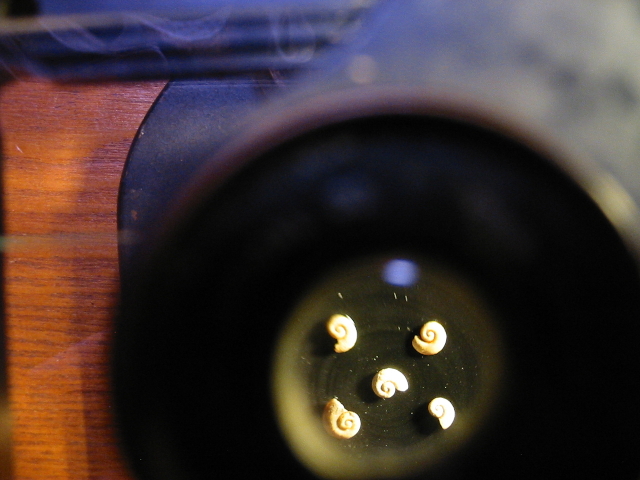
Five small conispiral gastropod shells

Five small conispiral gastropod shells

Using a fine camels hair brush one must apply adhesive either to the surface on which the specimen will be mounted or onto the underside of the specimen itself. For some adhesives a needle in a holder or hemostat will serve. Some adhesives are more forgiving than others as regards positioning, but at all costs one must avoid allowing any adhesive adhere to an observable surface. One should be aware that some adhesives dry opaque or with a gloss finish that will show conspicuously in the finished mount. For the smallest objects one may paint the entire surface with gum and allow it dry. When an object is placed one need only direct a breath of moist air onto the whole to render the gum adhesive.

Geometric arrangements are pleasing but utilitarian layouts have some advocates as well. One may wish to layout specimens so that they are within the field of view of a particular objective (I should post about that sometime) and such an arrangement may be made to permit isolated observation of an individual specimen.

This arangement offers differing perspectives of similar objects

This arrangement offers differing perspectives of similar objects

Post Placement

When the specimens have been placed one need only permit sufficient time for the moisture (that may or may not be) inherent in the adhesive to dissipate. In some areas (geographically speaking) and circumstances this may only entail permitting the slip to stand out in a dust free area for some minutes or hours. It is noteworthy that (in many locations) humidity will be lower in the winter and contribute to lower than general humidity (at ambient temperature) within the cell, which is desirable and will tend to prevent condensation on the underside of the cover glass.

Covering

Prior to sealing a cell mount one must be confident that the humidity of the specimen is lower than the humidity of any environment in which it is apt to find itself, and that the positioning is as perfect as it might be. Many adhesives will require several hours before the required conditions are met. However, once such is the case the cell should be sealed. Examine the slip under low power to ensure no dust has landed on the objects and all is as it should be.

Sealing

Sealing is distinct from covering in the sense only that a cell which is covered might still be exposed to the environment at large (yes such a thing exists). To ensure that the cell is sealed one must use a cover of a size for the cell. The underside of the cover should rest upon the top of the cell, and the edge of the cover should not extend beyond the outer surface of the cell. Place the cover across the cell first to verify the size. In the below image the figure on the left is correct. The above on the right shows a cover glass which is too small, below is one which is too large.

Post-it notes are excellent!

Post-it notes are excellent!

Some texts recommend heating the slip so that the shellac cell is rendered soft and then applying gentle pressure to the cover to form a seal. This method has the advantage of eliminating imperfect seals which result from imperfections in the top surface of the cell. Regrettably, this method may also tend to deform the cell if the slip is heated too much or for too long. One may achieve as effective a seal by painting a ring of fresh shellac on the cell before placing the cover glass. Once the cover glass is in place set a ring of shellac around the margins of the cover to ensure that the seal is hermetic. A few layers of shellac are recommended so that the cover is well secured mechanically.

At this stage the slide is complete. Once it has dried many persons elect to give the cell a coat of decorative paint. I find the appearance of plain (dark) shellac acceptable.

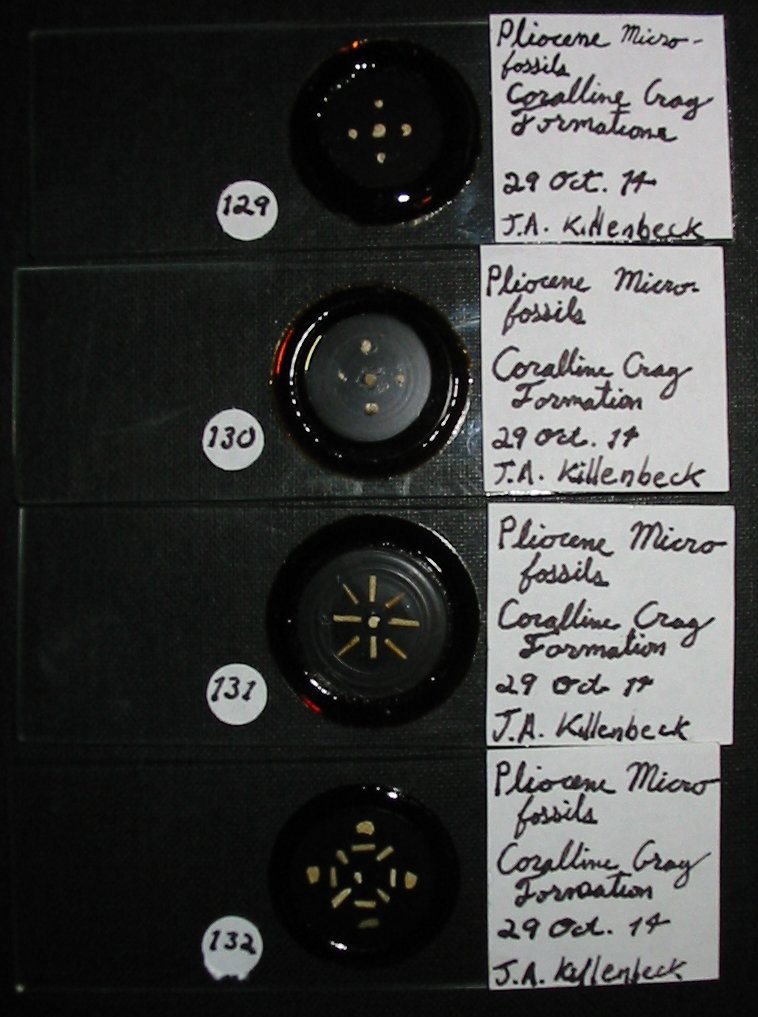
Note the errant adhesive on #130, that is why I do not reccomend rubber cement.

Note the errant adhesive on #130, that is why I do not recommend rubber cement.


Truly Traditional Mounts II

In a pinch one can get away with all manner of substitutions if any of the below is lacking, so don’t despair if one lacks some seemingly critical component. -K

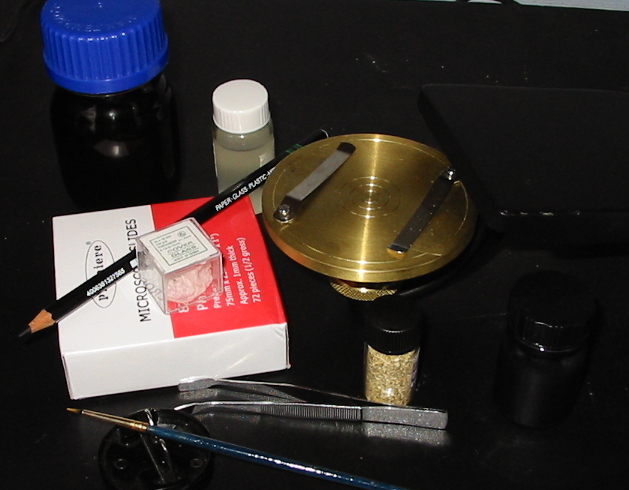
IMG_1526scalecrop

Supplies

Dry cell mounts can be somewhat labor intensive, particularly if only wet mounts have been produced in the past. A very small bit of practice goes a long way and attractive slides may be produced in no time at all. First, an accounting of the necessary materials;

  • A small, perfectly dry, specimen
  • A glass slip
  • A circular cover glass
  • A fine camels hair brush
  • A ringing table
  • Matte finish black paint, or india ink
  • Shellac
  • Tragacanth gum adhesive
  • A wax glass-marking pencil
  • A fine forceps
  • A centering card marked with the cover glass size to be used

Preparing the slip

For many other mounts preparing the slip means only laying out a cleaned slip from ones supply. Dry cell mounts are rather more involved so are not generally made on a moments notice. For that reason one may wish to ready a quantity ahead of time, rather than a single slip.

To begin with one will need to equip the slip first with an opaque surface on which to mount the specimen, and then by building a cell around that surface to support the cover glass. Place a cleaned slip onto the centering card and use the wax pencil to mark the center of the slip and the borders of the cover glass. The side that is marked will be the bottom of the slip so immediately turn it over to prevent accidental use of that surface. With the slip so marked one needn’t worry if the ringing table to be used lacks a marking for the size of cover glass that will be used.

Place the slip onto the ringing table (make certain the marked bottom of the slip is down) and center it. Set the table spinning and mark with black paint a circle of sufficient size for the intended specimen. Some practitioners paint only a small area and some paint the entire are that will be covered, the choice is immaterial as the entire field of view is sure to be opaque expect if viewed with the lowest powers (30mm or more). In either case lay down a layer thick enough to obscure all light. In the beginning one may wish to lay down a few trials on a test slip that may then be removed from the ringing table and held to a light to determine the effectiveness of the paint. If bubbles or imperfections are evidenced in the painted disc one may generally remove them by lightly moving the brush from the edge of the disc to the center and back as it spins. Allow the slip a few moments to dry. One may remove the slip to a covered box and paint discs on a quantity of slips in preparation for the next step, or leave it upon the ringing table with an improvised cover if only one is desired.

Once the opaque disk is dry paint a ring of shellac around it so that the outer edge of the shellac ring is just larger than the cover glass to be used. Load the brush lightly with shellac so that it does not tend to drip. If the shellac doesn’t flow easily from the brush wet the bristles first in alcohol. Lay a second layer of shellac over the first almost immediately and then permit it a minute or two to dry before laying down the third and successive layers. A cell of considerable hight, 1/8th of an inch (3.2mm)or more, may be prepared in as little as 15 minutes The width of the completed ring of shellac forming the cell should not be more than 3/32nds of an inch (2.4mm) with 1/16th (1.6mm) being ideal. Once the cell is of a suitable height place it into a covered box to dry for several hours, overnight is ideal. If the ring is not dry when a cover is placed on it there will be a tendency for it to deform and run in towards the object.

The shellac used (and the quality of the brush) has the more to do with success or failure than skill. Always use a finely pointed, scrupulously clean brush, and make note of the shellacs viscosity. If the shellac is too thick one will end up draping threads of shellac across the interior of the cell. Alternatively, if the shellac is too thin building up a cell of sufficient height will take a very long time. Should threads of shellac evidence after a few minutes of prior success simply cleaning the brush can help. Above all one should work deliberately and resist the urge to rush.

Coming up next, part III; actual mounting!

Truly Traditional Mounts I

The holidays is nothing if not cause to remember traditions. -K

In microscopy perhaps no slide is quite as traditional as the dry cell mount, a sealed air filled compartment protecting a dry object. Dry mounts took all sorts of forms from glass covered wooden slides, to full portions of insect, to diatoms and podura scales. However, of all the objects mounted dry perhaps none was quite so enjoyable (and now some common) as the mount of “Forams.”

IMG_1522_scalecrop

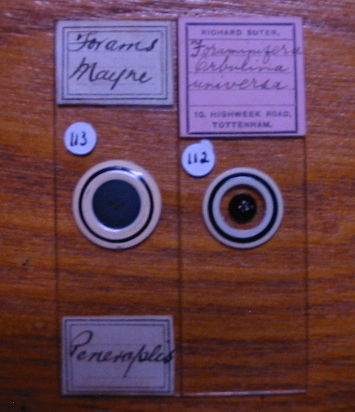
Forgive the catalog numbers.


Forams, or more accurately foraminifera, were among the most popular of the small fossil specimens to be mounted. In the present day one may be forgiven for questioning the designation as in the past it was somewhat of a common practice to label any small fossil thusly. The ease of acquiring them was no doubt a reason for their ubiquity. If one happens to live in an area that was formerly a body of water simply digging down a few feet in the garden (more about this come spring) will often reveal a layer of sediment full of a quantity of microfossils. Such were commonly mounted as an enjoyable object for examination with low power.

The traditional dry cell mount of forams is nothing more than a glass slip on which is mounted a specimen over an opaque surface. Around this is placed a cell, either a ready made one of aluminum (or these days of glass), or one built up of layers of shellac. The whole is covered by a circular cover glass which is sealed or cemented to the cell. The specimen may be then used as any other object for the microscope, secure from contamination and viewed as intended below a cover of recommended thickness.

To produce a traditional dry mount a few items will be required. Chief among them are a slide ringing table (for more on that see my earlier post on ringing a slide), a supply of round cover glasses, and a cell. For most practitioners the simplest means of producing a cell is by building one up from layers of shellac. One may use store bought, ready-made shellac of course, or the dry material dissolved in ethyl alcohol. If one is already possessed of an arbor press and a variety of circular punches one may form cells from aluminum with little trouble. Whether using shellac or aluminum one should fabricate cells so that they are only just thicker than the specimen vertically, and slightly larger than the cover glass diametrically.

For opaque mounted objects (such as forams) one will need a means of preventing light from penetrating the bottom of the slide. That need may be met easily by any matte finish black paint, though some practitioners will no doubt prefer to use black paper glued to the slip. One may try either and decide which is more to their liking, or trust to the greater convenience of either depending on the available equipment. With the contemporary popularity of scrap-booking circular paper punches may be had inexpensively and the chief argument against paper (the difficulty of true circles, discarded). Paper (of sufficient quality) is of uniform appearance and opacity throughout and lends itself to any number of adhesives. Paint is self adhesive in a way even modern gummed papers will never be and permits one to ensure perfectly central placement (as it is applied on the turntable), but may tend to be applied less then uniformly.

With a cell formed around the opaque disc one then affixes the perfectly dehydrated specimen so that it will not move. Historically, mounters used a variety of gum or albumen glues. Some in the present day may elect to use any of the plethora of artificial adhesives currently available, from rubber cement to cyanoacrylate the choices seem limitless. I confess to having always found tragacanth gum as the most effective and long lasting option. One need only add too a small quantity of the powdered resin (as it is commonly available) distilled water, which will then provide an effective and long-lasting adhesive that tends to prevent the condensation of moisture (by absorption of the same) in imperfect cells.

Do come by for the next (practical) post if you have any interest and in the mean time consider the application of the same methods for transmitted light mounts and other (think liquid without pressure) preparations as they will be elucidated some later time.

Book Review: Bacteria The Benign, the Bad, and the Beautiful

Not exactly a microscopy text but inspiration for breaking out the immersion oil certainly. -K

Written by Trudy M. Wassenaar, Bacteria: The Benign, the Bad, and the Beautiful something of a rarity in the continuum of microbiological texts; a work for public consumption. To understand the book, and more importantly enjoy it, one doesn’t need a scientific background or any sort of prior knowledge. It’s not even necessary for the reader to have a prior interest in bacteria, the book will surely engender one.

Pleasantly illustrated throughout, the book progresses in a natural way from one topic to the next. Topics as diverse as bacterial toxins, marine microbiology, and antibiotic resistance are all covered. So much more is covered as well, from technical subjects such as Type Three Secretion Systems and taxonomy to crowd pleasers like bacteria in art or the bacterial record holders. One is sure to be impressed by the shear volume of information packed into under 200 pages.

Written by a professional it is gratifyingly accurate and free of tedious in-line citations which the casual reader is sure to appreciate. Instead all relevant references are provided in the rear of the text. Most readers will quickly note occasionally unwieldy sentences. No doubt an artifact of either translation or the authors native language they do not render difficult the reading.

Available from all the usual places, I recommend the purchase. Seeing as it is published by Wiley anyone with a membership in the Royal Microscopical Society can make good use of the discount Wiley provides to members.