At times it seems that for every field that makes use of a light microscope there is a specialized stand. If not a particular stand, then an outfit of unique accessories. At the very least there’s optics for every occasion. A Bausch & Lomb Micro-Tessar objective is one more.
Just as photographers are wont to speak about portrait lenses when they mean Petzval’s so too are photomicrographers stage-whisper secretive when it come to Tessars. Although, a photographer who’s worked in a chemical darkroom is apt to know the Tessar as well, it frequently finding a place on the business end of an enlarger, for many a photomicrographer it is all too unfamiliar. Everyone knows about Flourites and Apochromats, even the utility of green filters for achromats, rather less know of Tessars.
A discovery of Zeiss, and therefore found in the Bausch & Lomb catalog only after the Triple-Alliance era, a Tessar lens is composed of four lenses (two each of crown and flint glass) with an aperture diaphragm between the first two lenses (which are separate) and the final two (which are cemented together. It’s an exceptional lens. With excellent correction for spherical aberration, a Tessar is likewise well corrected for color and astigmatism, which is to say it’s magnificently flat at even the lowest equivalent focus. A Micro-Tessar is such a lens outfitted in the RMS (society) thread. Although, B&L includes the LTM (M39) 72mm Teassar lens in their catalogs under the same designation.
Through the unimaginable generosity of a dear friend and member of that loose organization that is the community of microscopists a fine example of Micro-Tessar has been added to the collection. It’s a 48mm Micro-Tessar and though in need of a little cleaning quite irresistible. Here’s a few scans of negatives exposed just this past evening on the only film that wasn’t in the freezer (Ultrafine Xtreme 100) run through some Diafine that happened to be at the back of the shelf—a poor choice for a budget film but sure to compensate nicely for over or under exposure.
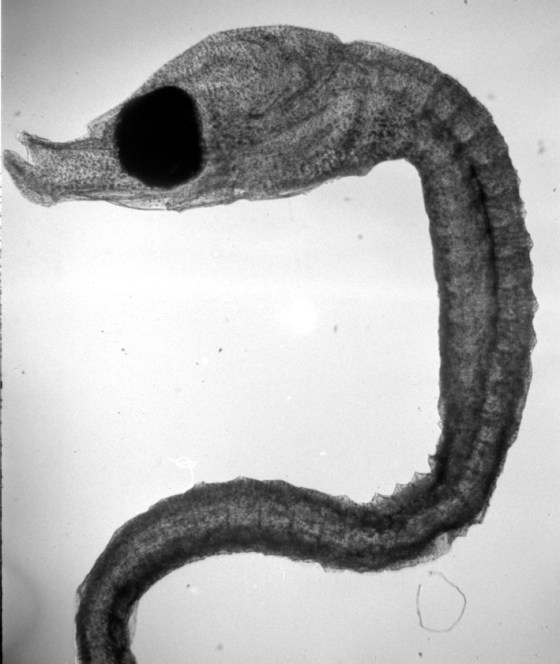
Young Pipe Fish, Bright-field, cropped
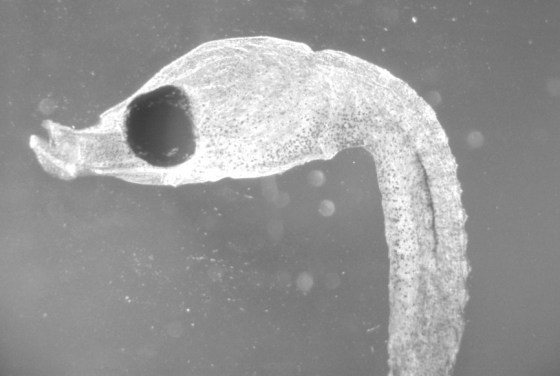
Young Pipe Fish, Dark-field, cropped
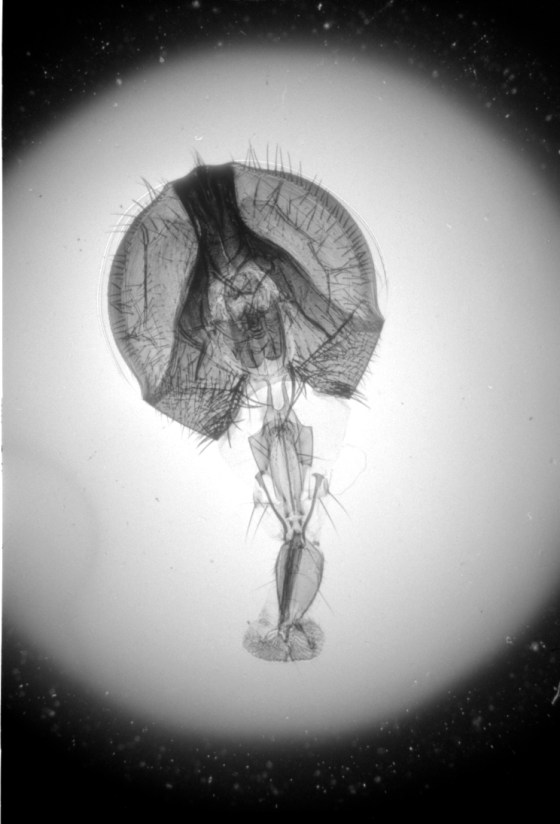
Head of a Blow-fly, Bright-field, un-cropped
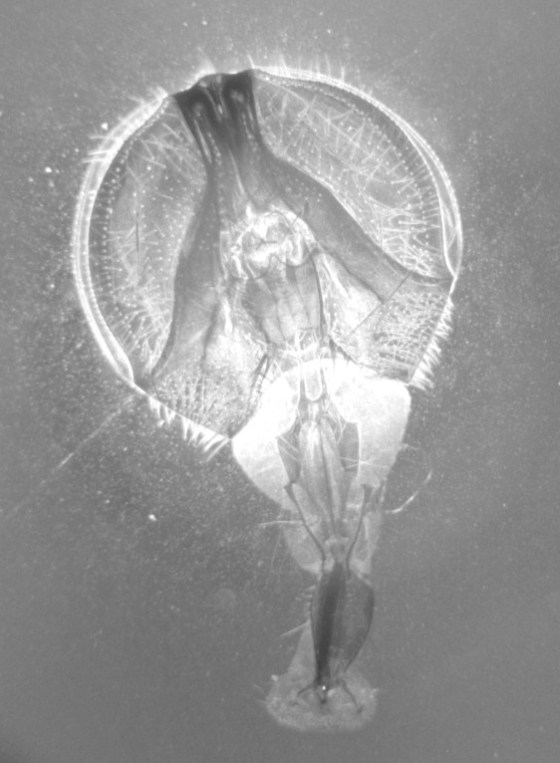
Head of a Blow-fly, Dark-field filter, cropped
In spite of the rush with which the above were produced, without an objective, and using a desk-lamp and mirror with no condenser, observe the above. The field of view on the first image is in excess of 9mm. That blow-flys head is 4500μm and this lens has oodles of dust on it. Only unavoidable scheduling conflicts prevent giving this lens the attention it deserves…
 vade mecum microscope